On Palantir's second-quarter 2026 earnings call, CTO Shyam Sankar gave investors a one-liner: "Remember, only Palantir has FDEs. Everyone else has sparkling sales engineers." He said it weeks after AWS and Microsoft committed billions to their own forward deployed units, and after OpenAI and Anthropic set up private-equity-backed firms to put engineers inside customer businesses.
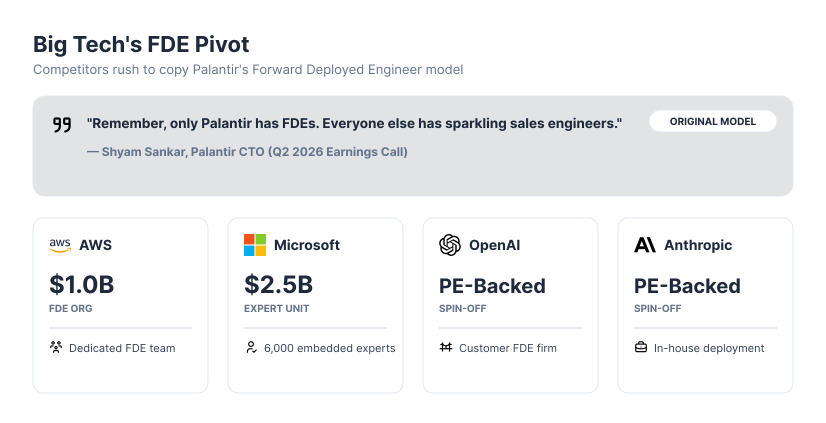
All four bets rest on the same premise: an AI agent succeeds or fails inside the customer's systems, with the customer's permissions, data, and approval chains. The model is the cheap part. Forward deployed engineering is the name the industry settled on for the work around it, and this guide covers how that work runs at a technical level, what it costs, and how to judge an engagement.
Short answer: Forward deployed engineering (FDE) is a delivery model in which a vendor's software engineers work inside a customer's organization to get the vendor's product running in production on the customer's real data and systems. The engineer writes production code, owns a business outcome, and feeds what they learn back into the vendor's product. Palantir popularized the model, and AI companies now use it to deploy agents.
Key takeaways:
- An FDE ships production code on the customer's live systems, owns a business result, and sends findings back to the product team. Without that loop, the job is consulting.
- The work follows an eight-step loop. The two steps teams skip most, building an eval set and generalizing what was built, decide whether the agent provably works and whether the vendor's product improves.
- AI agents revived the model. Their value depends on permissions, data access, evals, and process changes that a vendor cannot ship in a box.
- A real engagement leaves the customer able to run the system alone: infrastructure as code, evals, MCP servers, runbooks, and a trained owner.
- The 2026 hiring and funding announcements are large, but job-posting growth starts from a near-zero 2025 base.
What a forward deployed engineer actually does
The title comes from U.S. military jargon for forward-based units. Wikipedia, citing a 2009 article in Science, records Palantir using it by that year. Three traits separate the role from adjacent jobs:
- Production code. The FDE ships software that runs against the customer's live systems.
- Outcome ownership. The engagement is measured by a business result, such as tickets resolved or hours removed from a process.
- A loop back to the product. What the FDE learns in the field changes the vendor's roadmap.
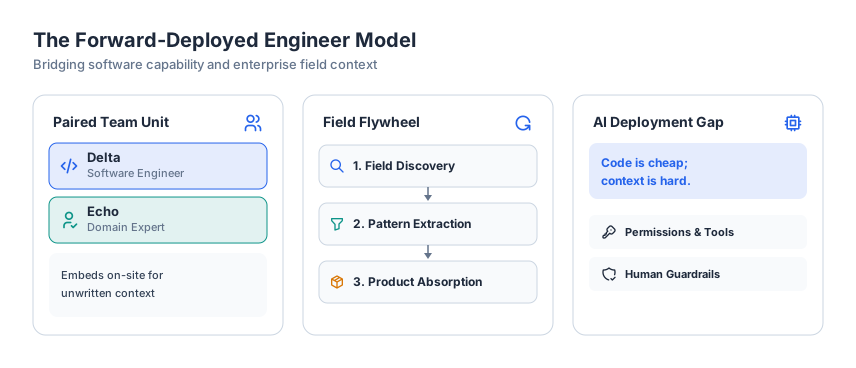
Palantir's own engineering blog describes the split in a short formula: a product engineer ("Dev") works on "one capability, many customers," and a forward deployed engineer ("Delta") works on "one customer, many capabilities."
FDE vs adjacent roles
The title overlaps with several older jobs, and some companies use it as a relabel. The table below shows where the lines usually fall.
| Role | When they engage | Owns production code? | Owns an outcome? | Feeds the product roadmap? |
|---|---|---|---|---|
| Forward deployed engineer | After the contract, for weeks to months | Yes | Yes | Yes, by design |
| Solutions or sales engineer | Before the sale | Rarely, demos and proofs of concept | No, owns the technical win | Informally |
| Solutions architect | Before and after the sale | Rarely, designs more than codes | Partly | Sometimes |
| Customer success or support engineer | After the sale, ticket-driven | Fixes and scripts | Retention | Through bug reports |
| Professional services or SI consultant | Project-based | Yes, often custom | Project delivery | Usually not |
The two roles most often confused with an FDE each have a full comparison:
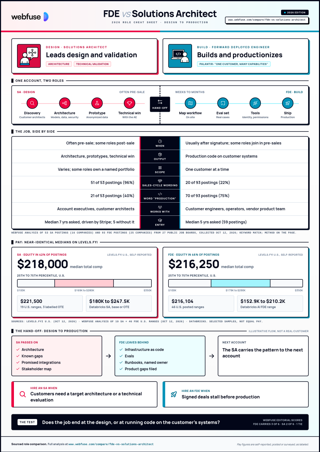
FDE vs Solutions Architect
Production code or architecture breadth compared: pay, pre-sale work, outcome ownership, and when to hire each.
Open the comparison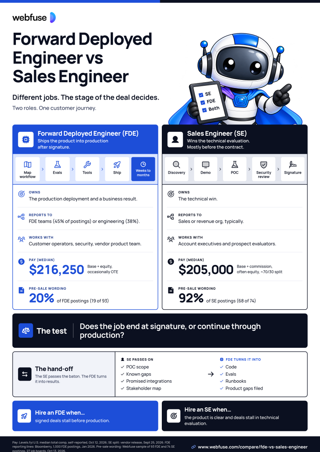
FDE vs Sales Engineer
Pre-sale demos or post-sale production code compared: pay, travel, the hand-off on one deal, and when to hire each.
Open the comparisonThe Pragmatic Engineer's 2025 reporting on OpenAI shows the line in practice: OpenAI solutions architects tend to build MVPs offline with anonymized data, and FDEs write code directly on customer infrastructure. That habit of working on the real system goes back to the role's origins at Palantir.
Where the model came from
Palantir built the model for customers whose requirements could not be written down. Intelligence and defense work involved undocumented schemas, classified context, and workflows that headquarters engineers would never see. Embedding engineers on site was the only practical way to discover what "working software" meant.
Sankar tells the origin story himself. According to The Register (October 3, 2026), he says he coined the term in 2007 after CEO Alex Karp asked why French restaurants are so good. Karp's answer was that the wait staff are part of the kitchen and know its techniques like the cooks do. Sankar says Karp asked him to build that for engineering. Treat this as founder lore: the only source is Sankar's own account.
Two structural details from Palantir carried into the current wave:
- The paired unit. Palantir pairs the Delta with an "Echo," a deployment strategist who is often not a software engineer. Practitioner accounts describe Echoes as domain operators, such as former officers or clinicians, who handle stakeholders, adoption, and account shape. Palantir's own blog on the deployment strategist role describes the job, and the Delta and Echo labels still appear as team names on Palantir's own job board.
- Field-heavy staffing. The Pragmatic Engineer reports that until about 2016, Palantir had more FDEs than regular software engineers. After Foundry launched that year, many moved into product engineering as the platform absorbed patterns they had built by hand.
That second point is the model in miniature: field work finds patterns, the product absorbs them, and the next deployment needs less custom code. AI agents added a third piece, shown on the right of the diagram: the code got cheap, and the context around it did not.
Why AI agents brought the model back
Enterprise software has always had an implementation gap. Agents widen it. A chatbot needs a model and a knowledge base. An agent that changes records needs credentials, scoped permissions, tool definitions, a test suite of real tasks, rollback paths, and a process that knows when to stop and ask a person.
OpenAI FDE Luis Velasco described this at the Shift conference in September 2026, as reported by ShiftMag on October 2:
"Code is very cheap to produce. It's all about building the system around it."
He described that system as "the system of intent, the guardrails, the constraints for the agent to work reliably," and called access to a company's data, procedures, and tools "the deployment gap."
He also noted that agents now handle far longer tasks, from work a human would finish in about six minutes to work of around 16 hours. He was citing METR's published time-horizon benchmark, and the six-minute and 16-hour figures are his summary of it. Longer tasks touch more systems, so the deployment gap grows with them.
The production gap in numbers
Several figures circulate about agent failure. Each measures something different, so read them one at a time:
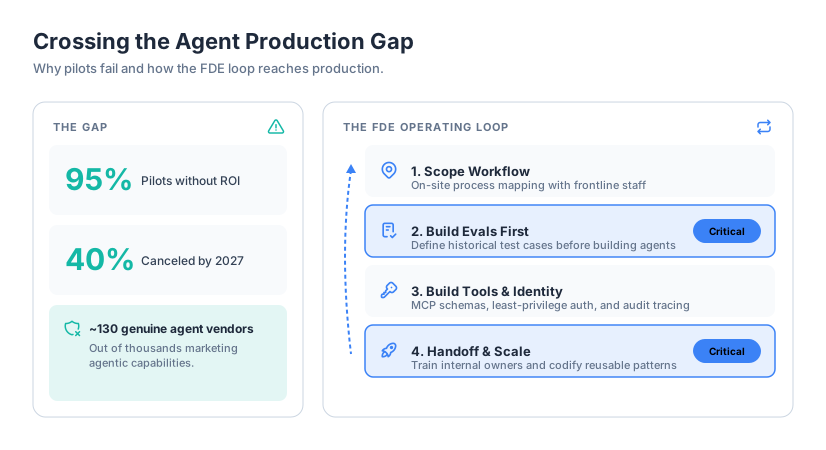
- Gartner forecast, June 25, 2025. In a press release, Gartner predicted that over 40% of agentic AI projects will be canceled by the end of 2027, citing escalating costs, unclear business value, or inadequate risk controls. The 40% is a prediction about 2027. A January 2025 Gartner poll of 3,412 webinar attendees in the same release found 19% had made sizeable agentic investments, 42% conservative ones, 8% none, and 31% were waiting or unsure.
- "Agent washing." In the same research, Gartner estimated that only about 130 of the thousands of vendors marketing agentic AI offer genuine agentic capability. The number is an analyst estimate.
- MIT NANDA, 2025. The GenAI Divide report found that about 95% of organizations saw no measurable return from generative AI pilots. Its method combined a review of 300+ publicly disclosed initiatives, interviews with 52 organizations, and a survey of 153 leaders. The result rests on disclosures and a survey, and it covers all generative AI pilots, agents among them.
Figures such as "88% of agent pilots never reach production" circulate in blog posts without a traceable primary report; treat them as secondary claims.
Forward deployed engineering is the vendors' answer to that gap. The right side of the image below condenses the FDE's work into four stages; the next section breaks them into the full eight-step loop.
The FDE operating loop
The loop below reflects how OpenAI, Anthropic, and Palantir describe their deployments, plus common practitioner writeups. Real engagements compress or repeat steps, but the order holds.
- Embed and scope. Spend the first days on site with the people who do the work as well as the sponsor. The Pragmatic Engineer describes OpenAI FDEs starting with a short on-site scoping phase.
- Map the real workflow. The documented process is almost always shorter than the real one. Capture exceptions, side spreadsheets, approvals that live in someone's head, and the systems people copy data between.
- Sort every step. Each step lands in one of four buckets: delete it, automate it with plain rules, give it to an agent, or keep it human. Many steps should never reach a model.
- Build the eval set before the agent. Collect real historical cases with known correct outcomes. This becomes the definition of "working" that both sides sign off on.
- Build inside the customer's tools. Agents call the customer's existing systems through defined tools, and those systems stay in place. This is where MCP servers and tool schemas get written.
- Productionize identity and permissions. Give the agent its own identity, least-privilege scopes, secrets management, audit logs, and tracing from day one.
- Hand off. Transfer code, infrastructure, evals, and runbooks to a named internal owner, and train that team to change the system without the vendor.
- Generalize. Report which parts were custom and which were repeatable. OpenAI's Deployment Company page calls this cycle "build, prove, generalize," with recurring patterns moving into products such as its Agent SDK, authoring systems, and reliability tools.
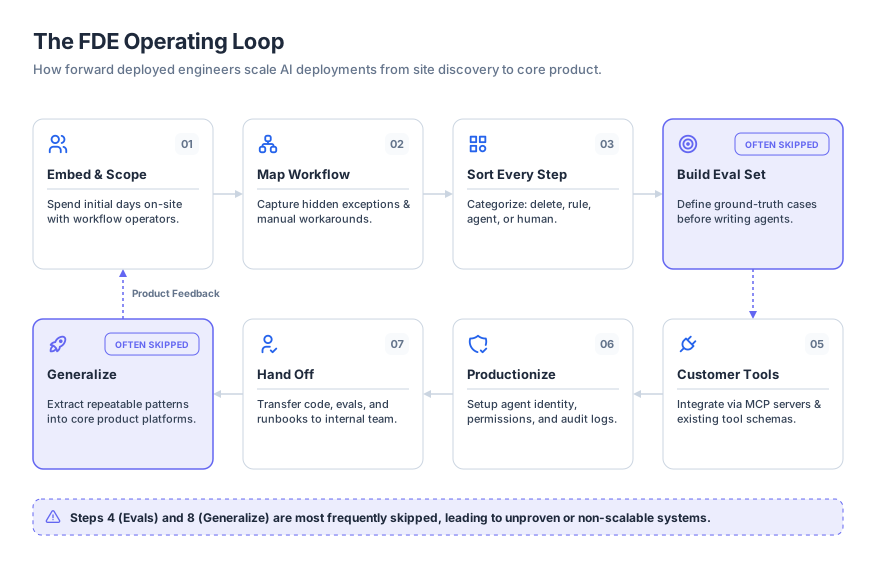
Steps 4 and 8 are the ones most often skipped:
- Skipping step 4 means nobody can prove the agent works.
- Skipping step 8 means the vendor is running a services business with a product attached.
What a typical week looks like
Engagement shapes vary widely:
- Palantir historically kept engineers on site for months.
- AWS describes 45-day sprint cycles, and coverage of the launch reported pods of about five or six engineers per client.
- Anthropic's Applied AI FDE listing calls for 25-50% travel to customer sites, so many lab FDEs split time between customer sites and remote work.
Inside a sprint, a common rhythm looks like this:
- Early in the week: sessions with operators and a review of last week's eval failures.
- Midweek: build time, including permission requests that need the customer's security team.
- Late in the week: a sponsor review against the agreed metric and a written note to the vendor's product team on what the platform could not do.
Those notes are the raw material for step 8.
The build time in the middle of the week goes into a production stack, and that stack is what the customer inherits.
The technical stack an FDE builds
Practitioner writeups in 2026 describe layered production stacks, and the exact layers vary by vendor. The four-layer version below is a synthesis of those accounts, read from the bottom up.
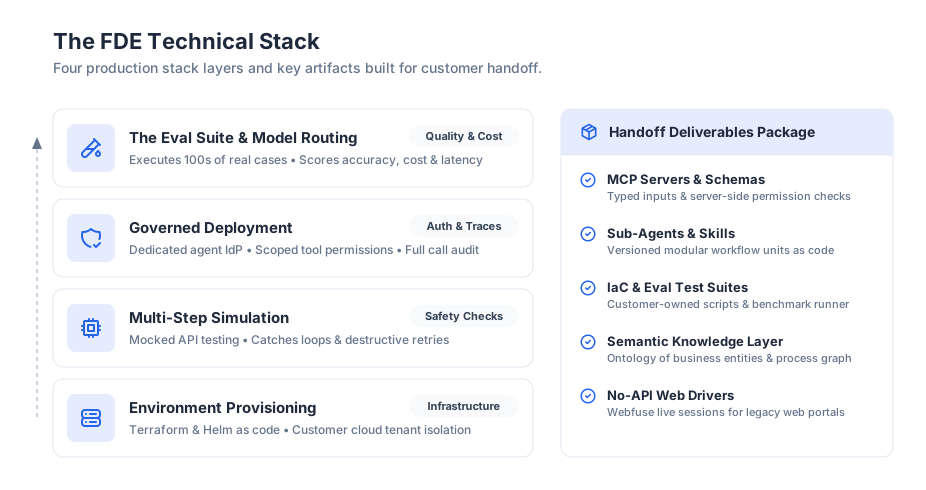
Environment provisioning
Everything runs in the customer's cloud account or tenant, defined as code. Terraform or Helm templates create the runtime, connect to SSO, wire up a secrets manager, and isolate each business unit or customer. An environment that exists only as an FDE's console clicks is one the customer cannot rebuild.
Simulation
Before an agent touches production, it runs multi-step tasks against mocked tools that mirror the real API shapes. Simulation catches loops, bad retries, and destructive sequences without side effects.
Governed deployment
Agents need identities the way service accounts do. In practice this means:
- A dedicated agent identity in the customer's identity provider, separate from every human account.
- Scoped permissions per tool, with read and write separated and high-risk actions behind a human approval step.
- Observability from day one: traces of every model call and tool call, linked to the business record it touched.
The eval suite
The eval set is the contract in executable form. A useful suite holds a few hundred real cases per workflow, scores both the final outcome and the intermediate tool calls, and runs on every prompt, model, or tool change. It tracks cost and latency per task alongside accuracy, which makes model routing a measured decision: use the cheapest model that clears the bar for each step.
Together with simulation, it covers both sides of readiness: simulation measures safety, and the eval suite measures quality.
The right side of the diagram, the handoff package, is what the customer keeps once the stack is running.
Artifacts: what should exist after the FDE leaves
The clearest change between Palantir-era and agent-era forward deployment is the deliverable list. Anthropic's Applied AI FDE listing asks engineers to "deliver technical artifacts for customers like MCP servers, sub-agents, and agent skills that will be used in production workflows," and to "identify and codify repeatable deployment patterns."
A complete handoff package usually contains:
- MCP servers and tool schemas that wrap the customer's internal systems with typed inputs, clear descriptions, and permission checks enforced in the server code, where a prompt cannot override them.
- Sub-agents and skills for repeatable tasks, versioned like code.
- Eval sets and the runner that scores them.
- Infrastructure-as-code in the customer's account.
- Runbooks for incidents, model upgrades, and permission changes.
- A semantic layer where needed. AWS says its teams leave behind a knowledge graph of the customer's business entities and processes, which AWS's Francessca Vasquez describes as "a customer's ontology of their information." SiliconANGLE called this a "system of intelligence" for agents.
MCP matters here for a practical reason. A tool defined once as an MCP server can be reused by any compliant agent client, so the customer keeps using it after switching models or vendors. Tool schemas written as functions inside one vendor's framework stay tied to that framework.
When there is no API
Some workflows live in web applications the customer uses but does not own: a supplier portal, a government filing site, a legacy SaaS tool with no usable API. FDEs can wait for an integration that may never come, or have the agent operate the web interface directly. Webfuse is one option for the second path: a live-session MCP that lets an agent work inside a live web session of a site the vendor does not control, with no change to that site's code. Browser-automation frameworks and cloud browsers are the other common choices, with different trade-offs on authentication and human handoff.
That is the work. The next question is who is paying for it, and at what scale.
Who is building FDE teams in 2026
Hiring and capital figures in this section come from company announcements and press coverage; none are audited.
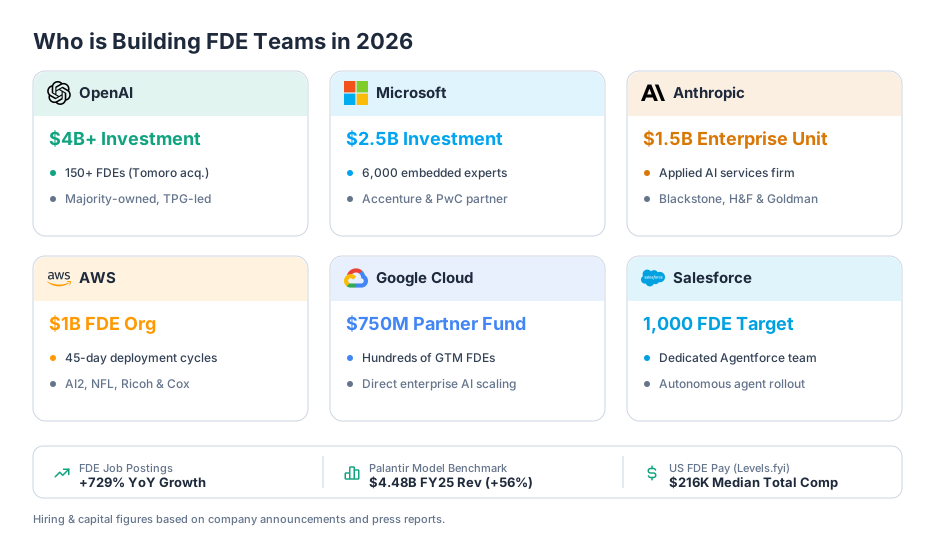
Where each card comes from, with the details that did not fit on it:
- OpenAI announced the OpenAI Deployment Company on May 11, 2026. OpenAI holds a majority stake, TPG led the initial investment, and the Tomoro acquisition brings about 150 FDEs and deployment specialists.
- Anthropic announced its enterprise AI services firm with Blackstone, Hellman & Friedman, and Goldman Sachs on May 4, 2026. The $1.5 billion figure comes from CNBC's reporting.
- AWS launched its Forward Deployed Engineering organization on June 30, 2026, per SiliconANGLE. Named customers include the Allen Institute for AI, Cox Automotive, the NBA, the NFL, and Ricoh.
- Microsoft announced Microsoft Frontier Company on July 2, 2026, working with partners such as Accenture and PwC. Land O'Lakes and Unilever are among the early customers.
- Google Cloud is hiring "hundreds" of FDEs inside its go-to-market AI organization, according to 2026 press reports, alongside the partner-ecosystem commitment.
- Salesforce "has committed to building a team of 1,000 FDEs" for Agentforce, according to its blog in November 2025 (APAC edition dated March 27, 2026).
How the labs fund it
The OpenAI deal terms show how a lab pays for people-heavy work. Axios reported a $10 billion pre-money valuation and a guaranteed minimum 17.5% return to investors, with profits capped. SiliconANGLE named Tomoro's prior clients as including Tesco and Virgin Atlantic. A guaranteed-return structure looks more like infrastructure finance than venture capital, and placing services in a separate vehicle keeps lower-margin work off the lab's own books.
Investors had already made the case for accepting that margin. a16z partner Joe Schmidt's "Trading Margin for Moat" (June 4, 2025) called the FDE "the hottest job in startups." His argument: AI applications should become the systems of work that generate and store company data, and young companies should accept less than 80% gross margin when that buys them ownership of the workflow. He cited ServiceNow's 63.2% and Workday's 54.1% gross margins at IPO as precedent.
Job postings
The hiring follows the money, from a tiny base. Business Insider, citing job-board data, reported that FDE postings in April 2026 sat about 5,230% above January 2025 levels, against 543% above in April 2025, which works out to the roughly 729% year-over-year increase on the card above. Other trackers report growth above 1,000% over different windows. When a January 2025 baseline is near zero, percentages inflate quickly; the installed base of FDEs remains small next to ordinary software engineering.
Palantir as the reference point
Palantir's results are the strongest public evidence that the model can scale financially. Its FY2025 earnings release and later results show the growth:
- FY2025 revenue: $4.475 billion, up 56% from $2.865 billion in 2024.
- Q2 2026 revenue: $1.935 billion, up 93%.
- Q2 2026 U.S. commercial revenue: $764 million, up 149%.
Its 2024 10-K lists short AIP bootcamps on customer data as a sales approach and warns that converting those pilots into long-term contracts is not guaranteed. Bootcamp conversion rates quoted online are company-reported or secondary.
What FDEs earn
Levels.fyi and job postings give the current picture:
- U.S. median total compensation: $216,250 for the FDE title on Levels.fyi in early October 2026, with the 25th to 75th percentile at about $179,000 to $290,000.
- AI lab base pay: Anthropic's Applied AI FDE listing posted a base salary range of $200,000 to $300,000 when we checked in October 2026 (it may since have closed).
- Sales quota: most postings carry none.
Treat all of these as self-reported or posted figures.
At those salaries, each FDE is an expensive hire, which makes the next decision a real one for any company: build the function or buy it.
How to build or buy an FDE function
Hiring is the hard part. The profile combines three things:
- A generalist production engineer: backend, APIs, cloud, data pipelines, SSO and RBAC.
- Shipped agent systems: tool use, MCP, evals, tracing.
- Process sense: as comfortable changing an operator's process as changing a prompt.
Sankar's description of the ideal Palantir candidate, quoted by The Register, is a person "crazy enough to get on a last-minute plane to Iraq," "smart enough to ship quality, same-day code," and with EQ "high enough to talk to users."
The judgment calls matter more than any single skill: what to leave manual, what to productize versus leave custom, and when to kill a pilot. Pair each FDE with a domain or deployment lead, Palantir's Echo pattern, so a second person owns stakeholders and adoption.
Real engagement or rebranded services contract?
Buyers face the mirror-image question: is the vendor's FDE offer the real thing? A few questions sort the two quickly.
| Question | Real FDE engagement | Rebranded services |
|---|---|---|
| Where does the code run? | In your account, defined as code | In the vendor's environment or a consultant's laptop |
| How is success measured? | An eval set and a business metric agreed up front | Hours, milestones, or a demo |
| What is left behind? | Evals, IaC, MCP servers or tool schemas, runbooks, a trained owner | Documentation and a renewal quote |
| Does the vendor product change? | Yes, field findings reach the roadmap | No visible link |
| Can you run it without the vendor? | Yes, by design | Not without a new contract |
The practical test is the last row. If the honest answer is no, the engagement has built a dependency, whatever the job titles say. Even a real engagement carries risks, on both sides of the contract.
Risks and failure modes
Rebrand risk. Wikipedia notes the role overlaps with solutions architects, sales engineers, professional services, and IT consulting, and cites a management professor who argued the unconventional title projects organizational identity more than it reflects a new occupation. The Register reported that cloud vendor DoIT has used embedded engineers since 2011 and adopted the FDE label only in Q4 2025.
Margin and scale. Headcount grows with every new customer. Palantir carried this cost for years before its platform absorbed enough patterns. Analyst Jay McBain, quoted by The Register, forecast that FDE investments will "fall back into the channel by 2031 when this matures."
Talent brittleness. Travel, ambiguity, short deadlines, and customer politics make the role unattractive to many engineers, and security-clearance requirements shrink the defense talent pool further. "Hottest job" rankings also overstate how many experienced FDEs exist today.
Lock-in by accident. An FDE who moves fast without IaC, evals, or a named owner leaves a system only the vendor can operate. The usual cause is deadline pressure. Contracts should list the handoff artifacts as deliverables.
What to take from this
Every lab and cloud vendor sells access to the same class of models. What separates a working agent from a canceled pilot is the work inside each customer: permissions, tools, evals, and process changes. Vendors that send engineers to do that work, write it down as reusable artifacts, and feed it into their products will compound their lead. Buyers can check which kind of vendor they have with one question: what will we own when the team leaves?
Frequently Asked Questions

Next Steps
Connect an agent to any web app
No signup, runs in your browser
Ready to let your AI agent act on the live web?
Headless browsers give your agent a copy of the web. Webfuse gives it the session your user is actually in — over MCP, with no install.
- No credit card
- Free forever plan
- Quick setup
Related Articles