- OpenAI FDE posting: "Write and review production-grade code across frontend and backend"
- OpenAI FDEs "write code directly on customer infrastructure and use customer tooling" (The Pragmatic Engineer, Aug 12, 2025)
- Databricks Sr. FDE posting: "delivering production-grade systems"
- The word "production" appears in 70 of 93 FDE postings (75%) and 21 of 53 SA postings (40%) (Webfuse keyword analysis, Oct 12, 2026)
Role Comparison
FDE vs Solutions Architect
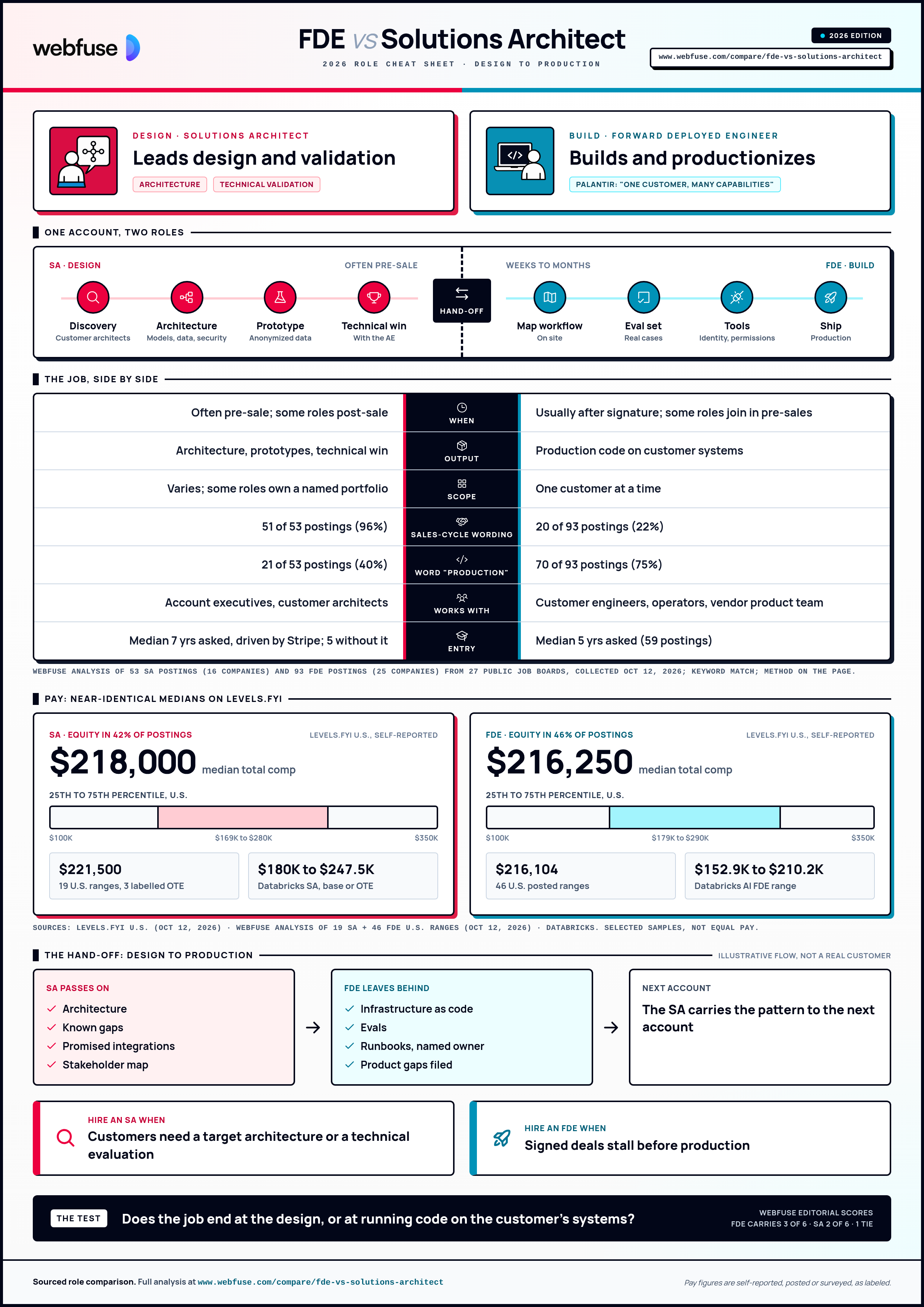
A solutions architect typically leads solution design and technical validation, often before the contract. A forward deployed engineer typically builds and productionizes the solution with the customer, one customer at a time. Median pay is almost identical on Levels.fyi: $216,250 for FDEs and $218,000 for solutions architects (U.S., self-reported, October 2026). One question sorts them: does the job end at the design, or at running code on the customer's systems?

Role cheat sheet (click to open)
- When
- Usually after signature; some roles join in pre-sales
- Often pre-sale; some roles post-sale
- Output
- Production code on customer systems
- Architecture, prototypes, technical win
- Scope
- One customer at a time (Palantir: "one customer, many capabilities")
- Varies; some roles own a named portfolio of accounts
- Works with
- Customer engineers, operators, vendor product team
- Account executives, customer architects
- Pay
- Equity in 46% of postings; commission wording in 9%
- Equity in 42% of postings; commission wording in 9%
Sources: job postings, Levels.fyi, The Pragmatic Engineer
Quick Quiz
Which role does your situation need?
Five questions for buyers, hiring managers, and engineers weighing a move. We point you to an FDE, a solutions architect, or both.
// Your situation
An FDE fits
Your answers point at production: code on customer systems, one customer at a time, and a result to own after go-live. That is the FDE job. Check that the role carries an outcome metric and a product feedback loop, or it turns into consulting.
The TL;DR
Two roles. Design or delivery.
Neither role replaces the other. Pick by what the customer needs next: a design or a running system.
Pick an FDE if...
- Signed contracts stall before production
- The product needs customer data, tools, and permissions to work
- Someone must own code on the customer's systems after go-live
- Field findings should change the product roadmap
- You can fund travel and deep time with one customer
Pick an SA if...
- Customers need a target architecture before they buy
- Deals need a technical evaluation, a prototype, or a proof of concept
- One technical lead should own the design across several accounts
- Account executives need a technical partner on strategy
- Delivery teams or partners will build what the design specifies
Head-to-head
The 6 Dimensions of the Job
Six dimensions, scored 1 to 10 by our editors from the sources cited on this page. A higher score means the role carries more of that dimension, not that it is the better hire.
Production Code Ownership
Both roles write code. The difference is where it ends up. The Pragmatic Engineer reports that OpenAI SAs build MVPs and proofs of concept on anonymized or offline data, and that FDEs write code directly on customer infrastructure with customer tooling.
- OpenAI SAs "rarely write code on customers' infrastructure" (The Pragmatic Engineer, Aug 12, 2025)
- Anthropic Applied AI Architect posting: "You ship prototypes regularly and can work in a real codebase"
- Databricks SA interviews include a live coding assessment in Python and SQL (posting, Oct 2026)
- OpenAI's architect brings in deployment and implementation specialists to "execute work where needed"
Production Code Ownership
Both roles write code. The difference is where it ends up. The Pragmatic Engineer reports that OpenAI SAs build MVPs and proofs of concept on anonymized or offline data, and that FDEs write code directly on customer infrastructure with customer tooling.
- OpenAI FDE posting: "Write and review production-grade code across frontend and backend"
- OpenAI FDEs "write code directly on customer infrastructure and use customer tooling" (The Pragmatic Engineer, Aug 12, 2025)
- Databricks Sr. FDE posting: "delivering production-grade systems"
- The word "production" appears in 70 of 93 FDE postings (75%) and 21 of 53 SA postings (40%) (Webfuse keyword analysis, Oct 12, 2026)
- OpenAI SAs "rarely write code on customers' infrastructure" (The Pragmatic Engineer, Aug 12, 2025)
- Anthropic Applied AI Architect posting: "You ship prototypes regularly and can work in a real codebase"
- Databricks SA interviews include a live coding assessment in Python and SQL (posting, Oct 2026)
- OpenAI's architect brings in deployment and implementation specialists to "execute work where needed"
Final Tally
Different jobs. Design and validation, or build and production.
No overall winner. Each role carries more of some dimensions, and one dimension is a tie. The Webfuse editorial scores below show which, with the evidence on this page.
Forward Deployed Engineer
// Running code, one customer at a time
Dimension Ratings
- Production Code Ownership9/10
- Architecture Breadth6/10
- Pre-sale Influence4/10
- Production Outcome Ownership9/10
- Time Inside the Customer8/10
- Hiring Pool and Ramp5/10
Solutions Architect
// Architecture and technical validation
Dimension Ratings
- Production Code Ownership5/10
- Architecture Breadth9/10
- Pre-sale Influence9/10
- Production Outcome Ownership6/10
- Time Inside the Customer5/10
- Hiring Pool and Ramp5/10
Method: Webfuse analysis of 53 SA postings (16 companies) and 93 FDE postings (25 companies) from 27 public job boards (Greenhouse, Ashby, Lever), collected Oct 12, 2026. Titles were matched by rule, deduplicated on company and title, and capped at 13 per company. Counts are keyword matches, not a reading of each role. FDE travel uses our Oct 7, 2026 set of 102 FDE postings. Dimension scores are Webfuse editorial scores based on the evidence on this page, not measured data.
Architects design the fit. FDEs wire it into systems the customer owns.
Webfuse lets the agent act in the live session.
Pay and hiring
Near-identical medians. Different pay mix.
Median total pay is almost identical on Levels.fyi: $216,250 for FDEs and $218,000 for solutions architects (U.S., self-reported, Oct 12, 2026). Posted U.S. ranges, read on the same day with the same rules, put the median midpoint at $216,104 for FDEs (46 postings, 18 companies) and $221,500 for SAs (19 postings, 12 companies). Our separate Oct 7 sample puts the FDE midpoint at $209,250 (28 postings with a USD base range, base only, from our FDE job postings analysis), so the figure moves with the sample. That is a market signal from selected, non-equivalent samples, not proof of equal pay. Every figure names its source, date, and type. Do not average across sources.
- Median posted midpoint $216,104 across 46 U.S. postings, 18 companies (Webfuse analysis, Oct 12, 2026)
- OpenAI FDE, San Francisco: $185,000 to $300,000 plus equity (posting, Oct 2026)
- Databricks AI FDE: $152,900 to $210,155; Sr. FDE: $182,000 to $250,208 (postings, Oct 7, 2026)
- Median posted midpoint $221,500 across 19 U.S. postings, 12 companies; 3 labelled OTE (Webfuse analysis, Oct 12, 2026)
- OpenAI Applied AI Architect: $156,600 to $276,000, the first of several posted ranges, with equity and commission (posting, Oct 2026)
- Databricks Solutions Architect: $180,000 to $247,500, base or OTE (posting, Oct 2026)
// Every figure, with its source
Where the U.S. medians land, by source
Levels.fyi - FDE
Median total compensation for the FDE title in the U.S., last updated Oct 12, 2026. 25th to 75th percentile $179K to $290K.
$216,250
self-reported
Levels.fyi - Solution architect
Median total compensation across 1,215 U.S. submissions, last updated Oct 12, 2026. 25th to 75th percentile $169K to $280K.
$218,000
self-reported
Our dataset - SA postings
Median midpoint of 19 U.S. posted ranges from 12 companies, Oct 12, 2026. 3 are labelled OTE (Harvey, Intercom, Vercel), and Databricks' ranges may be base or OTE.
$221,500
posted
Our dataset - FDE postings
Median midpoint of 46 U.S. posted ranges from 18 companies, Oct 12, 2026, same rules as the SA row.
$216,104
posted
Databricks posts $152,900 to $210,155 for an AI FDE and $180,000 to $247,500 for a Solutions Architect, and $182,000 to $250,208 for a Sr. FDE against $219,100 to $301,300 for a Sr. Solutions Architect. Databricks says its ranges are base salary "or on-target earnings for commissionable roles." BLS has no separate occupation for the title (O*NET files it under broader architect occupations, 15-1299.08 and 15-1241.00), so no BLS figure is shown. Self-reported and posted figures are not audited payroll data.
Where each one breaks
What goes wrong, and what goes wrong at the seam.
Both roles fail in known ways, and the worst failures happen at the hand-off from design to production. The items below come from job postings and the sources cited on this page.
Free implementation labor
With no outcome metric and no product feedback, the FDE does custom work the vendor never generalizes. That is consulting with a new title.
Webfuse analysis
Lock-in by accident
An FDE who ships fast without infrastructure as code, evals, or a named owner leaves a system only the vendor can operate. Contracts should list the hand-off artifacts as deliverables.
Webfuse analysis
Talent is scarce
Travel, ambiguity, and production-engineering demands narrow the pool. 52 of 102 FDE postings state a travel percentage, with a median stated maximum of 40%.
Webfuse posting dataset, Oct 2026
A relabeled architect
a16z (Jan 27, 2026) notes Palantir recast solutions and integration engineers as FDEs. A posting with no production code and no outcome metric describes an SA, whatever the title.
a16z, Jan 2026
Prototype on clean data, production on real data
OpenAI SAs build MVPs and proofs of concept with "anonymized or offline cuts of data." Production runs on the real thing, and the gaps land on whoever deploys.
The Pragmatic Engineer, Aug 2025
A design with no builder
Scale AI's SA posting names separate commercial, delivery, and engineering owners. If the hand-off from architect to builder is not written down, design decisions lose their owner.
Scale AI posting, Oct 2026
Portfolio stretch
OpenAI's architect covers "a named portfolio of customers." Breadth across accounts limits time on any one deployment. This is our inference from the posting, not a measured result.
OpenAI posting, Oct 2026
Title drift
OpenAI and Anthropic call the role Applied AI Architect, and Databricks splits pre-sales SAs from post-sale Delivery SAs. Read what a posting asks for, not what it calls the role.
Job postings, Oct 2026
Both lists draw on job postings and reporting published between Aug 2025 and Oct 2026. Titles move fast: read what a posting asks for, not what it calls the role.
Use Case Picks
Which role fits the situation?
Six common situations with a defended pick, then the hand-off that connects the two roles on one account.
The customer needs a target architecture before buying
Architecture discussions, a prototype, and a technical win are the core of SA postings at Databricks, Stripe, and AWS.
Signed deals stall before production
The bottleneck is deployment. Someone has to write production code on the customer's systems and own the result.
Design reviews for several accounts
Some SA roles own a named portfolio, such as OpenAI's Applied AI Architect. Design reviews are core SA work.
An AI agent that acts inside customer systems
Agents need tools, scoped permissions, an identity, and an eval set built on real cases. That work happens on the customer's infrastructure.
Planning a cloud migration
AWS's SA posting describes helping organizations "migrate existing workloads to the cloud." Design and best practice come first.
Strategic AI account, end to end
The SA typically leads solution design and validation, the FDE typically builds and productionizes it with the customer. The hand-off decides how much is lost between them.
// One account, both roles
How the two roles work one account
- 1AE
Qualify
An account executive qualifies an insurer that wants an AI claims-intake agent.
- 2SA
Design and win the evaluation
The SA runs discovery, draws the target architecture across models, data, integration, and security, and builds a prototype on anonymized claims. Output: a technical win and an agreed design.
- 3SA + FDE
Hand off the design
Contract signed. The SA passes on the architecture, known gaps, promised integrations, and the stakeholder map.
- 4FDE
Build for production
The FDE maps the real workflow, builds an eval set from historical claims, connects tools to the claims system, sets agent identity and permissions, and ships.
- 5FDE
Hand over and feed back
The FDE hands runbooks to a named customer owner and files product gaps. The SA carries the pattern to the next account.
Illustrative flow built from the sources on this page. Not a real customer.
FAQ
Questions people actually ask
Short answers, each with its source and date.
Is a solutions architect the same as a forward deployed engineer?
No. Both are customer-facing technical roles, but the output differs. The Pragmatic Engineer (Aug 12, 2025) reports that OpenAI SAs "rarely write code on customers' infrastructure" and build MVPs or proofs of concept on anonymized or offline data, and that FDEs write code directly on customer infrastructure with customer tooling.
Do solutions architects write code?
Yes, mostly prototypes. Anthropic's Applied AI Architect posting asks for someone who ships prototypes regularly and can work in a real codebase, and Databricks interviews SA candidates with a live coding assessment. Production code on the customer's systems is more often FDE work: the word "production" appears in 70 of 93 FDE postings and 21 of 53 SA postings in our Oct 12, 2026 keyword analysis.
Who earns more, an FDE or a solutions architect?
Neither, on median data. Levels.fyi lists $216,250 median total pay for FDEs and $218,000 for solutions architects (U.S., self-reported, Oct 12, 2026). Posted U.S. ranges read the same day put the median midpoint at $216,104 for FDEs (46 postings) and $221,500 for SAs (19 postings, 3 labelled OTE). These are selected samples, so treat them as a market signal. Commission wording appears in 9% of postings for each role.
Is a solutions architect a sales role?
Often, but not always. In our Oct 12, 2026 keyword analysis, 51 of 53 SA postings use sales-cycle wording (pre-sales, POC, account executives, or sales team), and AWS's SA posting opens with its Global Sales team. Some SA roles are post-sale: Deepgram's SA owns customer engagements "in a post-sales capacity," and Databricks hires Delivery SAs as post-sale technical leads.
Can a solutions architect become an FDE?
Yes. Some FDE postings name the background directly: Ramp's Forward Deployed AI Solutions posting asks for "experience in solutions architecture, technical consulting, forward deployed engineering, or pre-sales engineering." The usual gap is production code depth and owning a system after go-live.
Why do OpenAI and Anthropic call it an Applied AI Architect?
It is their name for the solutions architect role in AI. Anthropic's posting describes the job as "a Pre-Sales architect," and OpenAI's describes the "CTO of your book of business" for a named portfolio of customers. Both companies hire FDEs as a separate role.
When should a company hire an SA vs an FDE?
Hire an SA when customers need a target architecture, a technical evaluation, or design reviews. Hire an FDE when signed deals stall before production and someone must write code on the customer's systems and own the result. Large AI accounts often need both, with a written hand-off between design and build.
What can an FDE do when the customer's workflow runs in a web app with no API?
Some workflows live in web apps the customer uses but does not own, such as a supplier portal or a legacy SaaS tool. An architect can design around it; the FDE has to make the agent work inside it. Webfuse is browser infrastructure for AI agents: it lets an agent work inside a live web session of a site the customer does not own, with no change to that site's code. Browser-automation frameworks and cloud browsers are the other common options.
Related reading
Ready to let your AI agent act on the live web?
Headless browsers give your agent a copy of the web. Webfuse gives it the session your user is actually in — over MCP, with no install.
- No credit card
- Free forever plan
- Quick setup