Short answer: A forward deployed engineer (FDE) and a technical consultant can do almost identical work at a client site. They differ in the business model: an FDE works for a product vendor, where deployment helps sell and keep the software, and a technical consultant works in a services model, where the client pays for delivery, time, or both.
| Forward deployed engineer | Technical consultant | |
|---|---|---|
| Employer | A product vendor | A services firm or a vendor's professional services team |
| What the customer mainly buys | Software; deployment work is bundled or priced to win the software deal | Delivery, priced by time, by project, or a mix |
| Measured on (in postings) | Production adoption, workflow impact, product feedback | Delivery against scope; firms track utilization |
| Deployment risk | Carried partly by the vendor, which needs the software to renew | Allocated through the contract, scope, and change requests |
| Where the lessons go | Into the vendor's product | Into the firm's playbooks |
| Travel (posting data) | Median stated maximum of 40% across 52 FDE postings with a figure | 50% on average in the Deloitte postings we read |
| Pay (posting examples) | Base plus equity; some use on-target earnings | Base salary range |
Contracts can mix both models, so each row shows the typical case.
Key takeaways:
- Both roles can write production code. FDE and consulting postings both describe taking systems from prototype to production.
- The commercial model is the clearest test. Ask what the customer pays for and who carries the cost when a deployment stalls.
- Incentives follow the model. FDE postings name adoption and product feedback as success measures; consulting firms report utilization (Accenture: 92%).
- Selected postings pay FDEs more. OpenAI posts $185,000 to $300,000 plus equity for an FDE, Deloitte $86,700 to $170,900 for a technical consultant, with no matching by level or city.
- The title no longer decides it. Accenture, McKinsey, Deloitte, and others now run, fund, or train FDE teams with the AI labs.
Is a forward deployed engineer just a consultant?
Partly. The job content overlaps heavily, and the case for "rebranded consulting" is stronger than most FDE articles admit.
Andreessen Horowitz made that case directly. In a January 2026 essay, a16z's Tom Hollands described Palantir taking its solutions and integration engineers, "typically among the lower-status roles in any engineering org," and giving them a new name. His verdict:
"The title gave the work prestige."
The standard rebuttal is that consultants advise and FDEs build. Gergely Orosz writes in The Pragmatic Engineer that consultants "make one-off recommendations, whereas FDEs generally work with customers, long-term." That fits a strategy consultant. A technical consultant, who ships code, fits it poorly.
Do both roles write production code?
Yes. Consulting firms hire engineers to build and ship systems, and FDE postings ask for the same skills.
- Thoughtworks, a technology consultancy, posted a Senior AI Engineer role in Singapore in October 2026: "Design, build and deploy GenAI applications using techniques such RAG, Agents, Multi Agent Systems etc., taking ideas from prototype to production."
- Deloitte's Patient Services Salesforce Technical Consultant posting asks for "1+ full life-cycle Salesforce implementation."
- OpenAI's FDE posting asks candidates to "Write and review production-grade code across frontend and backend."
Read side by side, the build work is hard to tell apart. Travel is close too: Deloitte asks for 50% on average and OpenAI for "up to 50%."
Picture both at one client (an illustrative composite). A regional insurer wants an AI agent to handle first notice of loss: read the claim email, check the policy, open the case in the claims system. Two badges show up in the project room on Monday, one from a large services firm and one from the AI vendor whose model the agent runs on. Both write code, both spend much of the week on site, and both sit in the same meeting with the insurer's security team. One person's hours will likely appear on next month's invoice. The other's are folded into a software contract. That split decides most of what follows.
What does the customer pay for?
The consultant's time is usually the product, and the FDE's time is usually a cost the vendor carries to sell and keep software customers. Public filings from the two archetypes show the gap.
Accenture's annual report on Form 10-K tracks a number that product companies rarely mention: "Utilization for fiscal 2025 was 92%." When people are the revenue, the share of their time billed to clients is a headline metric.
Palantir, which popularized the FDE role, reports the other shape. Its 2025 Form 10-K says the company earns revenue "from the sale of subscriptions to access our software platforms," with professional services alongside. On early-stage work, the same filing reads: "We conduct pilots and bootcamps with customers, generally at our own expense and without a guarantee of future returns."
Put the two filings side by side and the difference in model shows in every line:
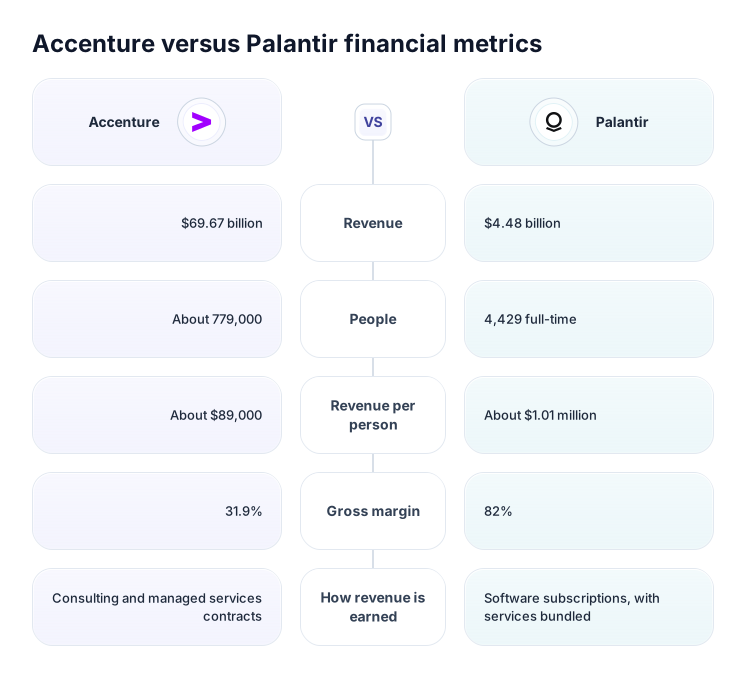
Both margins are GAAP gross margins from the companies' own filings, and revenue per person is our calculation. The comparison is still crude: Palantir's revenue comes from software sales, and most Accenture staff are not technical consultants. What it shows is the incentive each employer works under.
For the people in the project room, that incentive reaches the schedule. A firm running at 92% utilization needs its consultants billing again soon after an engagement ends, and the wider services market shows how hard that is. The 509 professional services organizations in SPI Research's 2026 benchmark, with over 245,000 consultants between them, averaged 66.4% billable utilization in 2025, down from 68.9% in 2024 and the lowest SPI has recorded, according to Certinia's summary.
So if the insurer's test environment is down for a week, the consulting firm can usually bill the time or raise a change request. Under a Palantir-style model, where pilots run at the vendor's expense, the vendor carries that week. Other FDE contracts split the risk differently. Who pays for the time also shapes what each engineer is asked to deliver.
What is each role measured on?
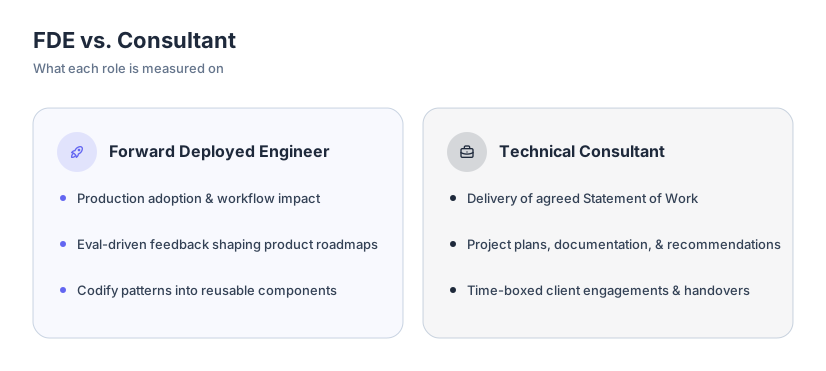
FDE postings measure production adoption and product feedback, and consulting postings describe delivery of an agreed scope. The difference shows in the verbs.
OpenAI's FDE posting states: "You will measure success through production adoption, measurable workflow impact, and eval-driven feedback that changes product and model roadmaps." It asks FDEs to "Codify working patterns into tools, playbooks, or building blocks that others can use."
A Deloitte Engineering Technology Strategy and Transformation consultant posting lists "Develop project plans, facilitate meetings with client and project leads, maintain project documentation" and "communicate recommendations." The engagement has a shape set by a statement of work, and Accenture's 10-K notes that "many of our consulting contracts are less than 12 months in duration" and can typically be ended "with as little as 30 days' notice."
Condensed, the two scorecards look like this:
At the insurer, both badges leave the claims connector, its tests, and a handover with the insurer's IT team. The customer's code stays with the customer either way. What differs is where the lesson goes:
- The consultant's lesson ("agents keep failing at policy lookup in legacy claims systems") goes into the firm's playbooks and the consultant's next engagement.
- The FDE's lesson is expected to reach the vendor's product team as a report, an eval, or a reusable component, so the next insurer needs less custom work.
Neither outcome is automatic. Consultants often write excellent handovers, and plenty of FDE field notes never reach a roadmap. Each employer rewards a different one, and pay follows the same split.
How do salary, travel, and career paths compare?
FDE postings list higher pay than the technical consultant postings we read, and travel is similar. These are selected postings from October 2026, not matched by level or city, so read the table as a market signal only.
| Role and source | Posted or reported pay | Travel |
|---|---|---|
| OpenAI FDE, San Francisco | $185,000 to $300,000, plus equity | Up to 50% |
| Databricks Sr. FDE, U.S. (October 7 snapshot) | $182,000 to $250,208 base | 20% |
| Palantir FDSE, U.S. | $135,000 to $200,000 base | 25% to 75% |
| Harvey Forward Deployed Finance Engineer | $254,600 to $350,000 on-target earnings, 75/25 split, plus equity | 2 to 3+ trips a month |
| U.S. FDE median total compensation (Levels.fyi) | $216,250 (self-reported, as of October 12, 2026; 25th to 75th percentile $178,750 to $290,000) | n/a |
| Deloitte Technical Consultant | $86,700 to $170,900 | 50% |
| Computer systems analysts, U.S. median (BLS, May 2025) | $105,850 | n/a |
| Management analysts, U.S. median (BLS, May 2025) | $101,860 | "Travel frequently" |
Two details matter more than the medians:
- Equity. OpenAI and Harvey list it on FDE roles, so an FDE at a growing vendor holds a stake in the product their field work improves. At a services firm, where revenue is billed time, upside tends to come through bonus and promotion.
- On-target earnings. Harvey's 75/25 split between fixed and variable pay is a structure more common in sales than in engineering, and worth checking in any FDE offer.
Variable pay is one of several places where FDE roles drift toward sales. The sales engineer comparison shows where that line sits:
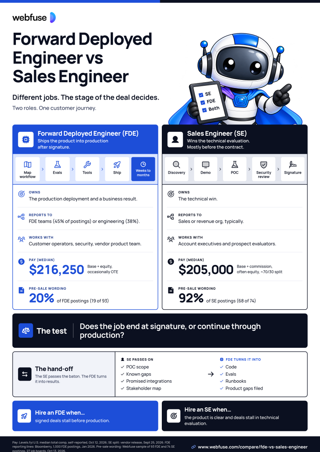
FDE vs Sales Engineer
Pre-sale demos or post-sale production code compared: pay, travel, the hand-off on one deal, and when to hire each.
Open the comparisonHow much do forward deployed engineers travel?
Most FDE postings mention travel, and the typical stated maximum sits between 25% and 50%. We counted it across 102 FDE postings collected on October 7, 2026 (method at the end of the article):
| Travel in FDE postings (n = 102) | Postings |
|---|---|
| No travel mentioned | 33 |
| Travel mentioned | 69 |
| Of those, with a percentage | 52 |
| Of those, wording only (for example "Expect regular travel for customer onsites") | 17 |
| Median stated maximum | 40% |
| 25th to 75th percentile of stated maximum | 25% to 50% |
| Stated maximum of 50% or more | 20 (3 of them at 75%) |
| Stated maximum of 25% or less | 17 |
Some of the 33 silent postings will still involve travel, so the real share of FDE roles that travel is likely higher than 69 in 102. Where a figure is named, FDE travel lands close to Deloitte's 50%.
Where each career leads
The ladders run in different directions. The consulting ladder is visible in Deloitte's own posting titles, from Consultant to Senior Consultant and on into manager roles, with progress tied to client delivery. The FDE path often bends back into the product: The Pragmatic Engineer reports that until about 2016 Palantir had more FDEs than regular software engineers, and that many moved into product engineering after Foundry launched.
Can a technical consultant become a forward deployed engineer?
Yes, and in 2026 it happened at company scale. The skills transfer well; the usual gaps are production ownership and code depth.
Client discovery, working inside someone else's systems, and getting through a security review are daily FDE tasks that consultants already know. OpenAI's posting asks for "5+ years of engineering or technical deployment experience that includes customer-facing work," which many technical consultants meet. The adjustment is owning a system after go-live and writing for a product team that will read the field report.
The largest example of the move is a whole consulting firm changing sides, part of a wider shift in how consultancies sell this work.
Why do consulting firms now use the FDE label?
AI vendors need more deployment engineers than they employ, so the largest consultancies now supply, partner on, or train FDEs. "Consultant or FDE" has become a question about the engagement, whatever logo the employer has. Three moves in 2026 show it:
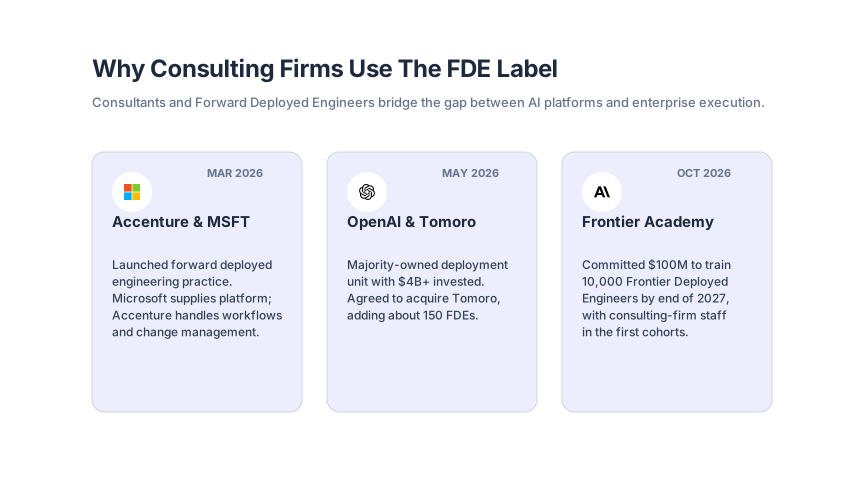
The names behind each move are the same firms that sell consulting hours. Accenture's practice with Microsoft promises "thousands of AI-skilled engineers". Bain & Company, Capgemini, and McKinsey are among the 19 investors in OpenAI's Deployment Company. Engineers from Accenture, Bain, Capgemini, Deloitte, and McKinsey sit in the first cohorts of Anthropic's Frontier Academy.
The Tomoro deal is the clearest case. Tomoro, "an applied AI consulting and engineering firm," brings about 150 engineers into an FDE unit by changing their employer. Their skills do not change overnight; who pays them and what their work feeds into does. The reverse holds too: an "FDE practice" inside a consulting firm that bills clients for engineer time runs on a services model. That is a different contract, and a legitimate one.
Does the blocker tell you which one you hired?
No. In week two at the insurer, both badges hit the same wall: the claims workflow runs through a third-party policy portal the insurer licenses but does not own, with no API and every login tied to the adjuster's single sign-on and MFA prompt.
Both engineers may reach the same architecture decision:
- An API where one exists.
- A headless workflow for unattended jobs with service credentials.
- The adjuster's own browser session, with the agent acting inside it, when identity and human takeover matter. Webfuse, our product, supports this pattern; the live web architectures guide compares all of them.
The commercial difference remains. The consultant delivers the workaround within an engagement; the FDE is also expected to turn it into a reusable product capability. That leaves the buyer's question: which of the two should you bring in?
Which one should you hire?
Hire a technical consultant when you want scoped delivery you pay for directly, and an FDE when the vendor's product is the core of the system and you want the vendor to share deployment risk. Four questions sort most offers, from either side of the table:
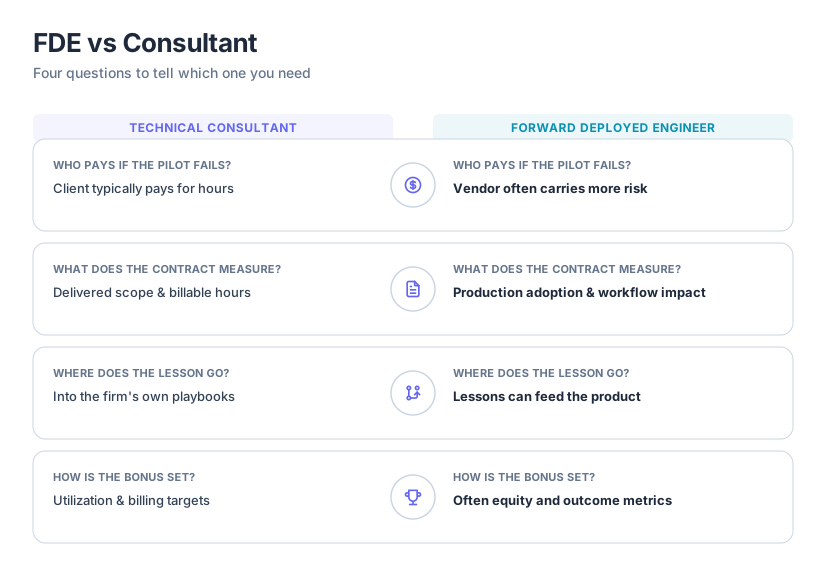
Then ask for proof. A vendor that says field work feeds the product should be able to name a feature that started at a customer site. If nobody can, the FDE you are hiring will likely work like a consultant, whatever the title says.
The bottom line
FDEs and technical consultants build the same kind of systems, often in the same project rooms, and the 2026 deals have blurred the employers too. What separates them is the contract around the work:
- Who pays for the time: the client, hour by hour, or the vendor, out of software revenue.
- What counts as success: delivered scope, or adoption and a better product.
- Where the lesson goes: a firm's playbook, or the next release.
Pay currently favors the FDE side in the postings we read, and consultants have a clear path across. Before choosing either role, or hiring one, read the contract before the title.
Back in the project room, both badges can do excellent work on the same claims agent. After go-live, the consultant moves to the next engagement. The FDE, if the model works as intended, sends the policy-portal lesson home so the next insurer starts with it solved.
Methodology and sources
- Business model figures: Accenture's fiscal 2025 8-K earnings exhibit and 10-K (fiscal year ended August 31, 2025); Palantir's 2025 10-K (year ended December 31, 2025). Both gross margins are GAAP figures as reported. Revenue per person is our calculation.
- Postings: Deloitte, OpenAI, Palantir, Harvey, and Thoughtworks postings were read on October 12, 2026. Pay ranges are posted ranges, not salaries.
- Travel dataset: we pulled public job-board feeds from Greenhouse, Ashby, and Lever for 54 company career boards on October 7, 2026 (Databricks figures come from the same pull). A posting counted as FDE when the title contained "forward deployed" or "FDE" plus "engineer"; manager, lead, architect, strategist, intern, and pre-sales titles were excluded. Titles were deduplicated on company plus exact title, and companies with more than 13 FDE titles were randomly sampled down to 13. Travel was read only from sentences containing "travel"; where a posting gave several figures, we used the highest. The sample leans toward AI and developer-tool companies and is not a random sample of the market.
- Self-reported and survey data: Levels.fyi U.S. median and percentiles read on October 12, 2026; BLS medians from the May 2025 release; the SPI Research utilization figure via Certinia's and Deltek's summaries of the 2026 benchmark (the full report is paid).
- Analysis vs fact: the insurer scenario is an illustrative composite, not a client engagement. Statements on how the roles differ in general are our reading of the sources above.
- Disclosure: Webfuse is our product and supports one of the architecture options named in the blocker section.
Frequently Asked Questions

Next Steps
Connect an agent to any web app
No signup, runs in your browser
Ready to let your AI agent act on the live web?
Headless browsers give your agent a copy of the web. Webfuse gives it the session your user is actually in — over MCP, with no install.
- No credit card
- Free forever plan
- Quick setup
Related Articles