As of November 2026, 2 of the 627 top websites we could load register WebMCP tools: chatgpt.com and redbus.in. Meanwhile, 91 of the 96 Shopify stores we sampled (95%) already expose 12 tools to AI agents.
Key findings
We scanned Chrome's top 1,000 websites (816 sites after merging domains) with WebMCP turned on, on November 25, 2026.
2 of 627 reachable sites register WebMCP tools on their homepage: chatgpt.com (14 tools) and redbus.in (2 tools, 9 more on its search results page).
Shopify leads adoption by far: 91 of 96 real stores (95%) expose the same 12 tools for search, cart and checkout, and Chrome users get them without a flag.
Most of the web still has no agent tools, so AI agents keep working through buttons and forms on almost every site.
WebMCP is the browser API that lets a page tell an AI agent what it can do: search, add to cart, book a seat. Chrome and Edge run it as an origin trial, and announcements from Shopify, Cloudflare and OpenAI suggest it is spreading fast. We wanted a number instead of an impression, so we loaded the most visited websites in the world and asked each one for its tools.
WebMCP adoption in numbers
We took the top-1,000 list from the Chrome UX Report for October 2026, merged origins of the same domain into 816 sites, and opened each homepage in Chrome 158 with WebMCP turned on. Then we asked every page for its tools for 10 seconds.

In numbers: 627 of 816 sites loaded (76.8%), 142 blocked our browser with bot walls or 403/429 errors (17.4%), 47 failed with a timeout, crash or DNS error (5.8%), and 2 registered WebMCP tools (0.2% of all sites, 0.3% of the ones that loaded).
The 189 blocked or failed sites are unknown, so the honest reading is "at least 2 of 816". Even if every unknown site supported WebMCP, which is very unlikely, top-site adoption would stay under a quarter.
A second number tells the more interesting story. In a random sample of Shopify stores from the top 50,000 sites, 91 of 96 real stores (95%) registered WebMCP tools. Platform defaults, rather than individual websites, are driving adoption.

Which top websites support WebMCP?
Only two sites in the top 1,000 answered with tools, and they show two very different uses.

Here is what each one exposes.
chatgpt.com: 14 tools for its own chat
ChatGPT registers 14 tools on its homepage, all about driving the chat itself: start_conversation, submit_conversation_message, set_composer_draft, select_conversation_model, upload_conversation_files, open_conversation, stop_conversation and more. An agent in the browser can open a chat, pick a model, attach files and send a message without clicking through the interface. The first tool appeared 2.4 seconds after the page started loading.
It fits OpenAI's wider push: the ChatGPT desktop app already calls other sites' WebMCP tools as "site tools", and OpenAI ran a WebMCP Challenge for apps built on the standard.
redbus.in: bus search, then seats and checkout
redbus.in, India's large bus-ticket site, registers searchBuses and get_bus_offers on its homepage. On a search results page (Bangalore to Chennai) it registers 9 different tools: applyFilters, showSeats, selectSeat, selectBoardingPoint, selectDroppingPoint, getBookingSummary, continueToCheckout and two more. It is the clearest example in our data of a site exposing a full booking flow, step by step, as the user moves through it.
That second finding matters for anyone measuring WebMCP: tools are registered per page. A homepage-only scan like ours undercounts sites that only add tools on search, product or account pages.
Neither site carries a WebMCP origin-trial token, so regular Chrome users only see these tools with the testing flag on. They look like production code waiting for the API to ship by default.
Most websites don't offer agents any tools yet.
Webfuse lets your agent work on any live website.
Why Shopify stores lead WebMCP adoption
Shopify adds WebMCP tools to its storefronts for every merchant, and our sample shows it working at scale. 90 of the 91 stores with tools exposed exactly the same 12:
| Area | Tools |
|---|---|
| Catalog | search_catalog, browse_store, get_product, show_variant |
| Cart | get_cart, create_cart, update_cart, cancel_cart |
| Checkout and orders | proceed_to_checkout, manage_orders |
| Store and buyer | ask_business, get_ucp_profile |
One store added a 13th tool, describe_loyalty_program, which suggests merchants or apps can extend the set. The first tool appeared a median 5.3 seconds after navigation started, so agents should wait for the page's toolchange event instead of reading the list right away.
The bigger detail: 92 of 100 sampled stores carry Shopify's own WebMCP origin-trial token. Shoppers on Chrome get these tools today, with no flag. No other group in our data reaches real users at this scale.
The set also changes quickly. When we built our live WebMCP demo on a Shopify store in October, it had an add_to_cart tool; by November Shopify had replaced it with create_cart and update_cart. Agents that hard-code tool names break, so they should list tools at run time with document.modelContext.getTools().
What low adoption means for AI agents
If you build an agent that works on real websites, the data says to plan for two worlds.
- Shopify stores (and soon Cloudflare sites) offer structured tools. An agent can search, fill a cart and reach checkout without guessing at the page.
- Everything else, which is almost all of the top 1,000, offers nothing. The agent still has to read the page, find buttons and fill forms like a person, with all the fragility that brings.
Cloudflare's developer preview could change the second group quickly, since one dashboard switch adds tools to any site behind it. None of the 816 sites in our scan had switched it on yet.
How to check if a website supports WebMCP
You can repeat our check on any page in under a minute:
- Open Chrome with WebMCP available: either a site in the origin trial, or turn on
chrome://flags/#enable-webmcp-testing. - Open the page you care about, wait a few seconds, then open DevTools.
- Run this in the console:
"modelContext" in document;              // false = no WebMCP in this browser
await document.modelContext.getTools();  // [] = this page registers no tools
Check the pages an agent would actually use, not only the homepage. For Shopify stores there is a faster signal: every store with tools in our sample had modelContext in its raw HTML, so a plain curl and a text search are enough to estimate adoption across many stores.
Adding agent tools to a website you don't control
For the 99% of sites without WebMCP, you can't wait for every site owner. This is where Webfuse fits, with three parts working together:
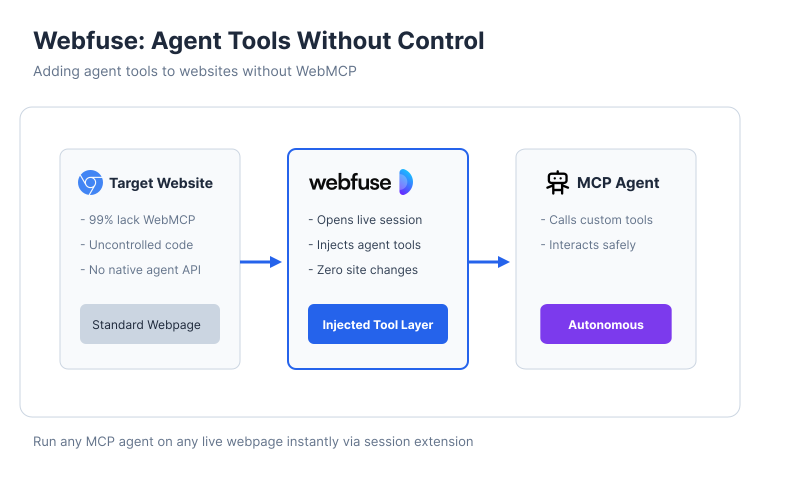
Webfuse opens any live website in a session, and an extension in that session adds tools for an agent on top of the page, without changing the site. Any MCP agent can then call those tools, as our WebMCP demo shows with a real store. Webfuse is our product, so weigh that suggestion accordingly.
See an agent use a real store's tools
Open a real Shopify store in a Webfuse session, run its WebMCP tools yourself, then connect your own MCP agent to the same session. Free, no signup, no flag.
Open the live demoThe bottom line
WebMCP adoption in November 2026 is narrow but real. Among the most visited websites, only chatgpt.com and redbus.in register tools, and only for users who turn on a flag. Shopify is the exception that makes the standard matter today: 95% of its stores expose the same 12 tools to every Chrome user. Expect the next jump to come from platforms such as Shopify and Cloudflare, rather than from websites one by one. Until then, agents need a plan for pages that offer no tools at all.
Methodology
- Site list: Chrome UX Report top-1,000 bucket, global, October 2026 (zakird/crux-top-lists): 1,000 origins, merged to 816 registrable domains.
- Browser: Google Chrome 158 stable, headless, driven by Playwright, with WebMCP enabled through Chrome's feature flags.
- Check: a fresh profile per site, the homepage only, then
document.modelContext.getTools()every second for 10 seconds. We also logged everyregisterToolcall and origin-trial tokens on the page. - Classes: "tools" means at least one registered tool; "blocked" means HTTP 401/403/429/503 or a bot-wall page; "error" means timeout, crash or DNS failure.
- Shopify sample: random sites from the CrUX top-50,000 bucket, checked for a Shopify storefront; the first 100 hits, minus 4 non-stores, gave 96 real stores.
- Limits: tools that appear only after login, after a click or on inner pages are not counted. The scan ran from Germany, so some blocks may be regional.
- Date: November 25, 2026.
Frequently Asked Questions

Connect an agent to any web app
No signup, runs in your browser
Ready to let your AI agent act on the live web?
Headless browsers give your agent a copy of the web. Webfuse gives it the session your user is actually in — over MCP, with no install.
- No credit card
- Free forever plan
- Quick setup
Related Articles