- Deepgram FDE posting: "Design, develop, and maintain production-scale integrations with the third-party systems that your customer runs on" (seen Oct 21, 2026)
- GitLab FDE posting: "Contribute production-quality code to GitLab's product and adjacent systems." (seen Oct 21, 2026)
- OpenAI FDEs "write code directly on customer infrastructure and use customer tooling" (The Pragmatic Engineer, Aug 12, 2025)
- The word "production" appears in 102 of 143 FDE postings (71%) (Webfuse sample, Oct 21, 2026)
Role Comparison
FDE vs Customer Success Engineer
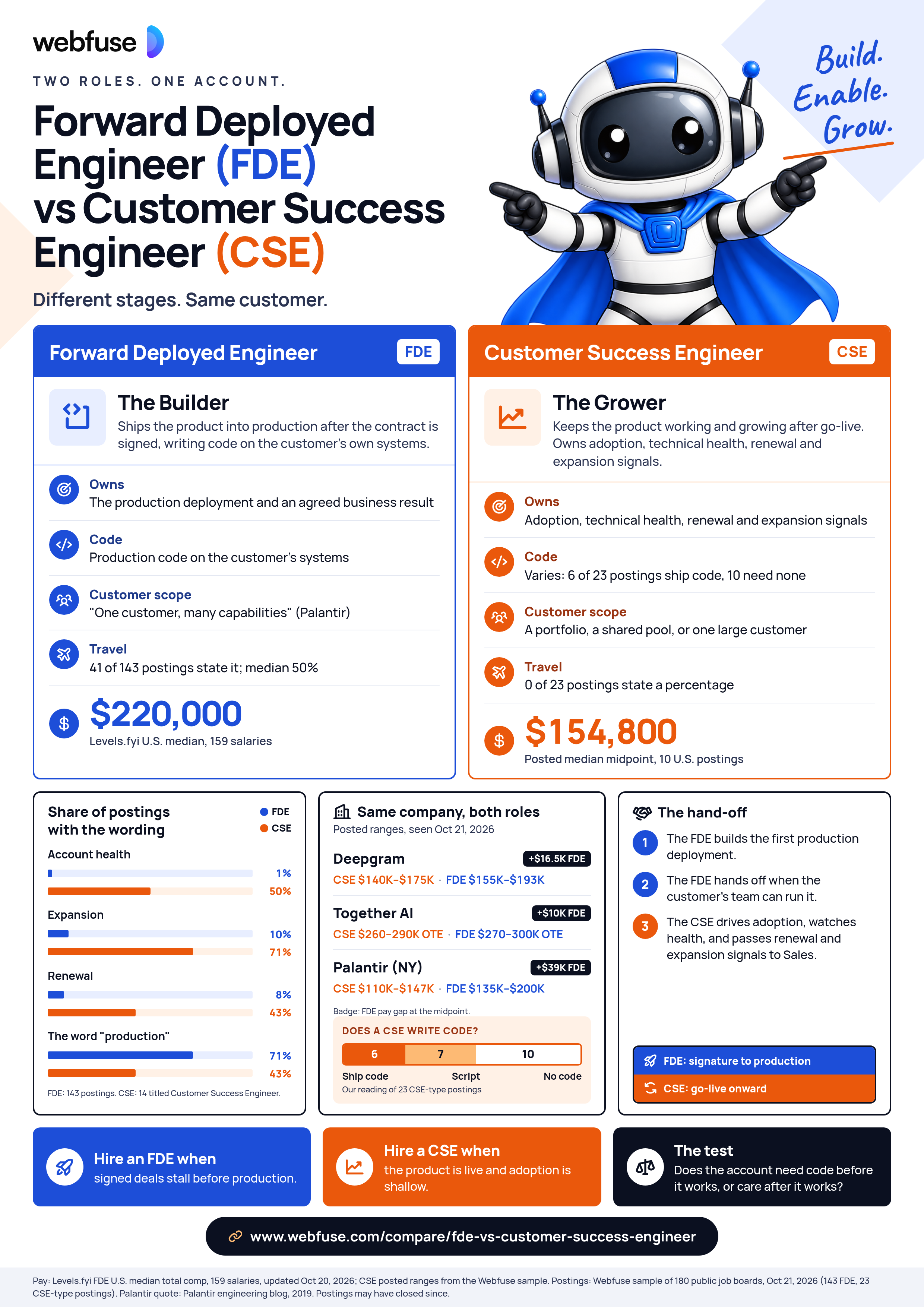
A forward deployed engineer gets the product live, writing production code on the customer's own systems. A customer success engineer keeps it in use after go-live: adoption, technical health, and the signals behind renewal and expansion. FDE pay runs higher, with a $220,000 median on Levels.fyi (U.S., 159 salaries, Oct 20, 2026). CSE roles in our Oct 21 sample posted a $154,800 median midpoint across 10 U.S. postings. The CSE title covers several different jobs, from support queues to single-customer technical owners, so the posting matters more than the name.

Role cheat sheet (click to open)
- When
- Mostly signature to production, weeks to months
- Onboarding onward, for the life of the account
- Owns
- Production deployment and an agreed business result
- Adoption, technical health, renewal and expansion signals
- Reports to
- FDE team (45%) or engineering (38%); CS 7% (Bloomberry)
- Customer Success org (GitLab, Deepgram, Sonar postings)
- Works with
- Customer engineers and operators, vendor product team
- CSMs, account executives, renewals, support
- Pay
- Levels.fyi median $220,000 (159 salaries); base + equity
- Posted median $154,800 (10 U.S. postings); base + equity, sometimes variable
Sources: Bloomberry, GitLab handbook, Levels.fyi, job postings seen Oct 21, 2026
Quick Quiz
Which role does your situation need?
Five questions for CS leaders, buyers, and engineers weighing a move. We point you to an FDE, a CSE, or both.
// Your situation
A CSE fits
Your answers point at the live account: many customers, shallow adoption, and success measured by health, renewal, and expansion. That is the CSE job. Check the posting asks for real technical depth, since some CSE roles are a support queue under a new title.
The TL;DR
Two roles. Two stages of the account.
Neither role replaces the other. Pick by where your accounts get stuck: before go-live, or after it.
Pick an FDE if...
- The product needs code on the customer's systems before it works at all
- Signed deals stall before production
- An AI agent needs customer data, tools, and permissions
- You have a few large accounts, not hundreds
- An outcome metric is agreed before the work starts
Pick a CSE if...
- The product is live but adoption is shallow
- One person has to cover many accounts or a pooled segment
- You need technical health checks, QBRs, and expansion signals
- Developer customers need guidance more than custom builds
- Renewal risk shows up as technical friction
Head-to-head
Where the Two Jobs Split
Six dimensions, scored 1 to 10 by our editors from the postings and sources cited on this page. A higher score means the role carries more of that dimension, not that it is the better hire. The FDE leads on three, the CSE on three.
Production Code Ownership
This is where the two titles split most clearly. An FDE writes code that runs on the customer's systems and stays there. CSE postings range from "No coding required" to shipping small fixes in a customer's codebase, and most sit closer to the first.
- Deepgram CSE posting: "No coding required, but you're fluent in APIs, developer workflows, and real technical conversations." (seen Oct 21, 2026)
- Of 23 CSE-type postings we read, 6 ship code, 7 ask for scripting or automation, and 10 need no code (Webfuse reading, Oct 21, 2026)
- LiveKit's Developer Success Engineer is at the coding end: "write sample and production-quality code"
- GitLab's CSE advises "through Zoom calls and emails" after the sale (GitLab handbook, modified Sept 24, 2026)
Production Code Ownership
This is where the two titles split most clearly. An FDE writes code that runs on the customer's systems and stays there. CSE postings range from "No coding required" to shipping small fixes in a customer's codebase, and most sit closer to the first.
- Deepgram FDE posting: "Design, develop, and maintain production-scale integrations with the third-party systems that your customer runs on" (seen Oct 21, 2026)
- GitLab FDE posting: "Contribute production-quality code to GitLab's product and adjacent systems." (seen Oct 21, 2026)
- OpenAI FDEs "write code directly on customer infrastructure and use customer tooling" (The Pragmatic Engineer, Aug 12, 2025)
- The word "production" appears in 102 of 143 FDE postings (71%) (Webfuse sample, Oct 21, 2026)
- Deepgram CSE posting: "No coding required, but you're fluent in APIs, developer workflows, and real technical conversations." (seen Oct 21, 2026)
- Of 23 CSE-type postings we read, 6 ship code, 7 ask for scripting or automation, and 10 need no code (Webfuse reading, Oct 21, 2026)
- LiveKit's Developer Success Engineer is at the coding end: "write sample and production-quality code"
- GitLab's CSE advises "through Zoom calls and emails" after the sale (GitLab handbook, modified Sept 24, 2026)
Final Tally
Different stages. Build it in, or keep it growing.
No overall winner. The FDE carries the build, the CSE carries the account after it. The Webfuse editorial scores below show where each one leads, with the evidence on this page. A team with hundreds of live accounts gets little from a role built for one customer at a time.
Forward Deployed Engineer
// Signature to production, one customer at a time
Dimension Ratings
- Production Code Ownership9/10
- Adoption and Account Health4/10
- Account Coverage and Scale3/10
- Time Inside the Customer9/10
- Product Feedback Loop8/10
- Renewal and Expansion3/10
Customer Success Engineer
// Post-sale adoption and account health
Dimension Ratings
- Production Code Ownership4/10
- Adoption and Account Health8/10
- Account Coverage and Scale8/10
- Time Inside the Customer4/10
- Product Feedback Loop6/10
- Renewal and Expansion7/10
Method: Webfuse sample of 180 public job boards (Greenhouse, Ashby, Lever), collected Oct 21, 2026. Titles were matched by rule: 23 CSE-type postings at 14 companies ("customer", "developer", "partner", or "technical" success engineer; 14 of them titled Customer Success Engineer), 145 CSM, and 143 FDE postings at 52 companies. Deduplicated on company and title, at most 13 per company. Counts are keyword matches, not a reading of each role; the code split (6 / 7 / 10) is our reading of all 23 CSE postings. The boards lean toward AI and developer-tool companies, and the CSE sample is small. Dimension scores are Webfuse editorial scores based on the evidence on this page, not measured data.
CSEs keep accounts healthy. FDEs wire agents into systems the customer owns.
Webfuse lets the agent act in the live session.
Pay and hiring
FDE pays more. CSE pay data is thinner.
FDE pay runs higher, and the CSE data is thinner. Levels.fyi lists a $220,000 median for FDEs (U.S., 159 salaries, updated Oct 20, 2026). For CSEs we could not confirm a Levels.fyi figure, so the page uses posted ranges and PayScale instead. The fairest test is the same company hiring both roles, shown below.
- 25th to 75th percentile $172,000 to $300,000 (Levels.fyi)
- Median posted range midpoint $216,104 across 69 U.S. postings at 34 companies (Webfuse sample, Oct 21, 2026)
- GitLab Staff FDE, U.S.: $220,000 to $270,000 base (seen Oct 21, 2026)
- Different method: PayScale average base $85,669, 34 salary profiles, updated Sept 1, 2026
- GitLab CSE, U.S.: $105,600 to $158,400 base; Prefect Developer Success Engineer: $128K to $176K (seen Oct 21, 2026)
- Adjacent title for context: Levels.fyi technical account manager median $185,000 (122 salaries, Oct 2026)
// Same company, both roles
Same employer, both roles
Deepgram - Customer Success Engineer (Americas)
Base range plus equity and a bonus. The posting says "No coding required". Published Apr 24, 2026, seen Oct 21, 2026.
$140K–$175K
posted base
Deepgram - Forward-Deployed Engineer (Strategic Accounts)
Base range plus equity and a 10% annual bonus; production-scale integrations. Published Aug 22, 2026. Midpoint $16,500 above the CSE.
$155K–$193K
posted base
Together AI - Customer Success Engineer (GPU Cluster)
Named technical owner for one strategic customer. "$260-290K OTE + equity + benefits". Updated Sept 23, 2026.
$260K–$290K
posted OTE
Together AI - Forward Deployed Engineer (Inference & Post-Training)
"$270,000 - $300,000 OTE + equity + benefits". Updated Sept 23, 2026. Midpoint $10,000 above the CSE.
$270K–$300K
posted OTE
Palantir - Forward Deployed Enablement Engineer, Customer Success (New York)
Embedded with Palantir's customer success teams; triages support requests and joins a 24/7 on-call rotation. Seen Oct 21, 2026.
$110K–$147K
posted
Palantir - Forward Deployed AI Engineer (New York)
Seen Oct 21, 2026. Midpoint $39,000 above the CS-embedded role at the same company.
$135K–$200K
posted
In these three pairs the FDE band sits $10,000 to $39,000 higher at the midpoint. GitLab and LiveKit hire both roles too, but at different levels or in different countries, so we left them out. Postings may have closed since we read them.
Where each one breaks
What goes wrong, and what gets lost at the hand-off.
Both roles fail in known ways, and the costly failures happen at the hand-off. The items below come from job postings, practitioner writing, and the sources cited on this page.
The FDE leaves and nobody owns the account
FDE work ends when the deployment runs. Without a named owner after that, adoption and renewal drift. GitLab writes the hand-off into the FDE role: "from discovery through handoff."
GitLab posting, Oct 2026
Free implementation labor
With no outcome metric and no product feedback, the FDE does custom work the vendor never generalizes. That is consulting with a new title.
Webfuse analysis
Lock-in by accident
An FDE who ships fast without runbooks, evals, or a named owner leaves a system only the vendor can run. Roboflow hands off only when "the customer's team is equipped to operate it."
Roboflow posting, Oct 2026
Scarce talent
FDE postings ask for production engineers who travel: a median 5-year minimum, and a median 50% travel where a number is stated. Few engineers want both.
Webfuse sample, Oct 2026
The title covers a support queue
Prefect calls its Developer Success Engineer "a support role" with a queue and on-call rotation. Palantir's CS-embedded "forward deployed" role triages support requests. Read the duties, not the title.
Prefect and Palantir postings, Oct 2026
An advisor without hands
A CSE role that needs no code can explain the integration but cannot build it. Custom work then waits for someone else, and adoption stalls on the same blocker.
Deepgram posting, Oct 2026
A pooled model spreads thin
Pooled and one-to-many programs reach many accounts, with less time for each. Samsara's own posting says "A Customer Success Manager managing 350+ accounts can't do everything manually."
GitLab and Samsara postings, Oct 2026
A relabel in either direction
Chad Horenfeldt asked if customer success needs "a new name already". The reverse happens too: a role called forward deployed that does support triage. The code and the metric show which job it is.
Horenfeldt, Aug 26, 2025
Both lists draw on job postings seen Oct 21, 2026 and practitioner writing published between Aug 2025 and Oct 2026. The CSE title covers several different jobs, so read what a posting asks for, not what it calls the role.
Use Case Picks
Which role fits the situation?
Six common situations with a defended pick, then the hand-off that connects the two roles on one account.
Signed, but not live
Someone has to write production code on the customer's systems before the product delivers anything. That is FDE work.
Live, with low adoption across many accounts
Workshops, health checks, and best-practice guidance reach many accounts at once. GitLab and Deepgram run pooled CSE models for this.
An AI agent that acts inside customer systems
Agents need tools, scoped permissions, and an eval set built on real cases. That takes code in the customer's environment.
Hundreds of self-serve developer customers
Roboflow's CSEs run webinars, office hours, and structured learning paths so customers "progress independently."
A strategic account at churn risk, technical root cause
The CSE spots the risk and owns the relationship. GitLab brings in an FDE "when adoption, retention, executive confidence, or public trust is materially at risk."
QBRs, health reviews, expansion signals
Deepgram's CSEs "lead executive business reviews"; Sonar's hand expansion and renewal signals to Sales.
// One account, both roles
How the two roles work one account
- 1AE + SA
Close and validate
The account executive and solutions architect close the deal and validate the technical approach. Roboflow's FDE posting starts the FDE's work at exactly this point.
- 2FDE
Build the first production deployment
The FDE builds on the customer's systems: integrations, evals, permissions, and the first workflow that runs in production.
- 3FDE + CSE
Hand off when the customer can run it
The FDE exits once "the customer's team is equipped to operate it" (Roboflow). The hand-off carries runbooks, a named owner, known gaps, and the success metric.
- 4CSE
Drive adoption and watch health
The CSE tracks usage and health, runs workshops and business reviews, and spots churn risk early.
- 5CSE
Pass signals on, and call the FDE back
The CSE hands expansion and renewal signals to Sales. A new use case or a deep technical risk brings the FDE back in.
Illustrative flow built from public job postings (Roboflow, Lambda, Sonar, GitLab), seen Oct 21, 2026. Not a real customer.
FAQ
Questions people actually ask
Short answers, each with its source and date.
What is the difference between a customer success engineer and a CSM?
A CSM owns the relationship and the commercial side of a book of accounts: renewal wording appears in 74% of the CSM postings we sampled (Webfuse, Oct 21, 2026). A CSE is the technical counterpart. Postings ask it for adoption, technical health, troubleshooting, and workshops. Deepgram's posting puts it plainly: "You're not a traditional CSM or Technical Account Manager."
Is a customer success engineer the same as a technical account manager?
Sometimes. Together AI's CSE is the named technical owner for one strategic customer, which is close to a TAM. GitLab's CSEs work a pooled model with no assigned accounts. The title covers several jobs, so the posting decides. For pay context, Levels.fyi lists a $185,000 median for technical account managers (U.S., 122 salaries, Oct 2026).
Do customer success engineers write code?
Some do. In 23 CSE-type postings we read on Oct 21, 2026, 6 ship code such as bug fixes or sample code, 7 ask for scripting or automation, and 10 need no code. Deepgram's says "No coding required." LiveKit's asks the engineer to "write sample and production-quality code." An FDE writes production code on the customer's systems as the core of the job.
Who earns more, an FDE or a customer success engineer?
The FDE, in every comparison we could make. Levels.fyi lists a $220,000 median for FDEs (U.S., 159 salaries, updated Oct 20, 2026). The median posted range midpoint for CSE roles was $154,800 across 10 U.S. postings (Webfuse, Oct 21, 2026), and PayScale lists a $85,669 average CSE base (34 profiles). At companies hiring both, the FDE band sat $10,000 to $39,000 higher at the midpoint.
Can a customer success engineer become an FDE?
Yes, but the gap is production code. Bloomberry's look at 100 FDE profiles found no one who came from customer success; most came from software engineering (45%) or SE and SA roles (22%). Deepgram goes the other way and accepts FDE experience for its CSE role. A CSE who already ships fixes in customer codebases is closest to the move.
Is "forward deployed engineer" just a new name for customer success?
Not in the postings that define it. GitLab says its FDE role "isn't" a replacement for Customer Success Management. The relabel does happen at the edges: Palantir posts a "Forward Deployed Enablement Engineer - Customer Success" that triages support requests and joins an on-call rotation. Check for production code and an outcome metric.
Do customer success engineers get commission?
Rarely as a big share. 5 of 23 CSE-type postings mention commission, OTE, or variable pay (Webfuse, Oct 21, 2026). Deepgram's Scaled CSE lists "10% Variable pay" and Together AI posts its CSE as OTE. For CS teams overall, Mostly Metrics found "The VAST majority of CSMs are on plans where 20% or less of their comp is variable" (132 companies, Jan 25, 2026).
What can an FDE or CSE do when the customer's workflow runs in a web app with no API?
Some workflows live in web apps the customer uses but does not own, such as a supplier portal or a legacy SaaS tool. A CSE can document the workaround; an FDE has to make the agent work inside it. Webfuse is browser infrastructure for AI agents: it lets an agent work inside a live web session of a site the customer does not own, with no change to that site's code. Browser-automation frameworks and cloud browsers are the other common options.
Related reading
Ready to let your AI agent act on the live web?
Headless browsers give your agent a copy of the web. Webfuse gives it the session your user is actually in — over MCP, with no install.
- No credit card
- Free forever plan
- Quick setup