Voice AI agents break in predictable ways. The STT misreads a word and triggers the wrong action. The agent forgets what was said two turns ago. A user asks something slightly outside scope and hits a dead end. The response takes three seconds and the user assumes the call dropped. Someone calls in distress and gets a robotic recitation of account details.
None of these are unsolvable research problems. They are engineering and design gaps - specific, fixable, and common enough that most production voice agents will encounter all five. This article covers each failure in concrete terms and explains exactly what to do about it.
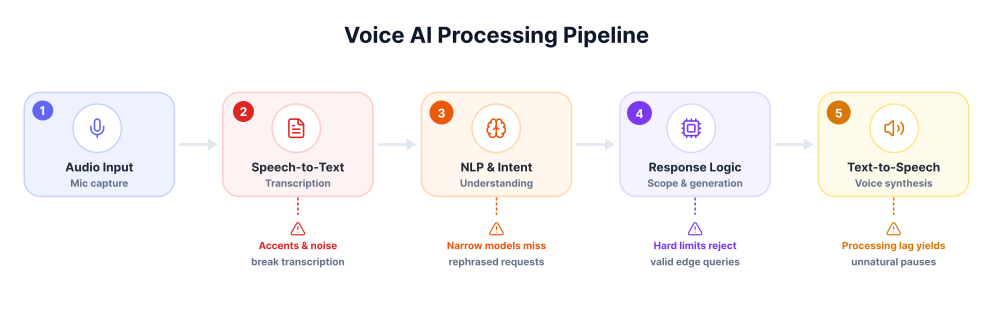
1. Incorrect Speech-to-Text Conversion and Intent Interpretation
Voice AI agents rely on accurately converting spoken words into text and then correctly identifying what the user wants. When this process fails, the agent cannot provide a helpful or relevant response. This often leads to user frustration and a breakdown in the interaction. These problems manifest in various ways, from simple transcription errors to complete misinterpretations of a user's goal.
A common real-world scenario: a user calls support and says "cancel my renewal," but background noise causes the agent to transcribe it as "cancel my annual." The agent pulls up annual plan details instead of processing a cancellation. The user repeats themselves twice, grows frustrated, and either hangs up or demands a human - an entirely avoidable failure.
- Irrelevant Responses: The agent gives answers unrelated to the user's actual question.
- Repetitive Clarifications: The agent repeatedly asks the user to rephrase or clarify their request.
- Task Failure: The agent attempts an action that does not align with what the user asked for, or fails to start any action.
- Long Interaction Times: Users spend too much time trying to get their point across, lengthening calls or sessions.
These issues often come from limitations in the agent's acoustic models or natural language processing (NLP) components. Background noise, diverse accents, rapid speech, and domain-specific terminology can all make speech conversion difficult. A narrow intent model may also struggle with varied phrasing or complex requests, even when the speech conversion is perfect. A useful benchmark: a word error rate (WER) above 10-15% in production typically translates directly into failed interactions - users begin dropping off when they have to repeat themselves more than once.
- Extensive Data Training: Train the speech recognition model with a wide array of audio data, including different accents, speaking speeds, and environmental noises. Modern STT providers like Deepgram (Nova-2 model) and AssemblyAI offer models pre-trained on millions of hours of diverse speech, which is a far better baseline than training from scratch.
- Domain-Specific Vocabulary: Create and regularly update a vocabulary list relevant to the agent's tasks. Most production STT APIs - including Deepgram, AssemblyAI, and Google Speech-to-Text - support keyword boosting or custom vocabulary, letting you weight industry terms, product names, and service details so the model favors them during transcription.
- Contextual NLP Models: Implement NLP models that consider the full conversation history and user profile to better predict intent. LLM-based approaches (using GPT-4o or Claude as the intent layer) handle ambiguous or varied phrasing far better than rigid rule-based classifiers or older slot-filling frameworks.
- Fallback to Human Agents: If the AI agent detects low confidence in its interpretation, it should offer a smooth transfer to a human support agent. Set a confidence threshold (commonly 0.6-0.7) below which the agent stops guessing and hands off instead. This prevents endless loops of confusion.
- User Feedback Loops: Log every interaction where the confidence score was low or the user had to repeat themselves. Review these transcripts weekly - even a sample of 50-100 failed calls is usually enough to surface the top misrecognized phrases and intent gaps. Feed those patterns back into your vocabulary lists and intent training data.
2. Difficulty with Multi-Turn Conversations and Context Retention
Voice AI agents frequently struggle to maintain context across several turns of a conversation. This limitation prevents them from engaging in natural, human-like dialogue, often leading to fragmented and frustrating user experiences.
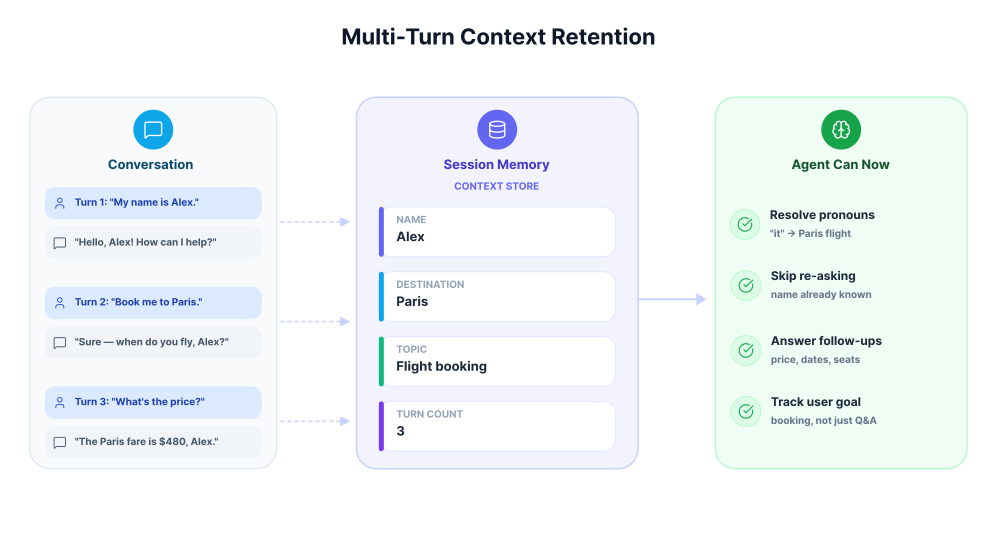
Consider this three-turn exchange with a travel booking agent. Turn 1: "I want to fly to Paris next Friday." Turn 2: "Make it business class." Turn 3: "What's the total price?" - a stateless agent hits turn 3 with no memory of Paris or business class, returns a confused response, and the user has to start over. Each turn was handled correctly in isolation; the failure is entirely in the connective tissue between them.
- Disregard for Prior Statements: The agent asks for information already provided by the user within the same interaction.
- Inability to Answer Follow-Up Questions: Users cannot ask clarifying questions about a previous agent response or build upon it.
- Fragmented Interactions: Each exchange feels like a new, isolated conversation, rather than a continuous dialogue with a memory of past inputs.
- User Frustration from Repetition: Users need to re-state information or re-explain their situation frequently, lengthening the interaction.
The core problem often lies in how the agent's memory and state management systems are designed. Many basic agents reset their understanding after each user utterance, failing to store or effectively retrieve details from earlier in the discussion. This can result from simple session limitations or a lack of sophisticated context-tracking mechanisms in the underlying AI models.
- Effective Session Management: The most direct fix is passing the full conversation history to your LLM on every turn - the same
messagesarray pattern used by the OpenAI and Anthropic APIs. Store each user utterance and agent response as it happens (in memory, or in Redis for multi-server deployments), then include the entire history in each new API call. This alone eliminates most context-loss failures. - Contextual Variable Tracking: As each turn is processed, extract and store key entities - dates, names, amounts, locations - in a session object alongside the conversation history. On each subsequent turn, inject these into the prompt so the agent can reference them explicitly, even if the LLM's attention drifts across a long conversation.
- Dialogue State Tracking: Maintain a lightweight state object that records the user's current goal and what information has already been collected. Frameworks like LangGraph are built specifically for this - they let you define conversation states as nodes in a graph, with conditional transitions based on what the user has and hasn't confirmed.
- Anaphora Resolution: When you pass full conversation history to a capable LLM (GPT-4o, Claude), pronoun resolution ("it," "that," "them") is largely handled automatically - the model has the antecedents in context. The failure mode is usually a missing history, not a missing capability.
- Conversation Testing: Rather than treating multi-turn failures as a training problem, write automated conversation tests: scripted dialogues where you assert the agent's state at each turn. Catching regressions early - before they reach users - is more practical than tuning after the fact.
3. Limited Scope and Handling of Out-of-Scope Requests
Voice AI agents are usually built to handle a specific set of tasks or answer questions within a defined knowledge domain. Users, however, do not always know these operational boundaries and might ask questions that fall outside the agent's programmed capabilities. This mismatch often leads to ineffective interactions, leaving users without the help they seek.
These problems surface when an agent cannot address even slightly related inquiries or offer guidance for topics it was not explicitly trained on. The result can be a rigid, unhelpful system that quickly diverts users to other channels, rather than providing a complete self-service option.
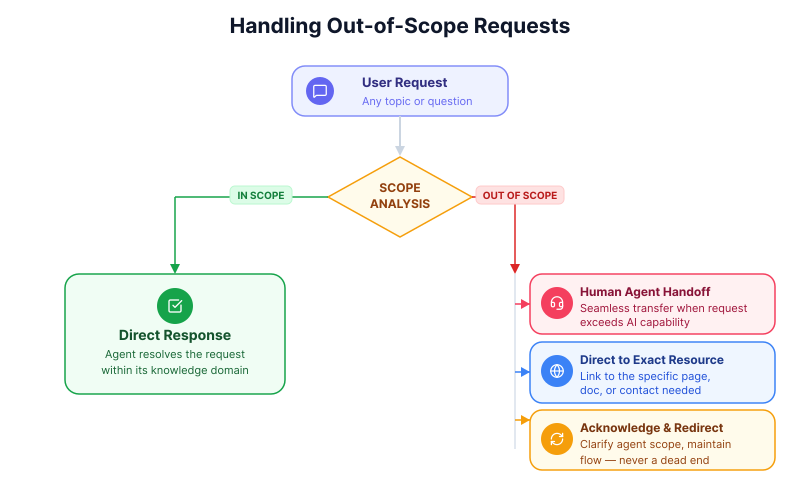
A typical example: a banking voice agent built to handle balance checks and fund transfers. A user asks "can you help me dispute a charge?" - a completely reasonable request for a banking assistant. The agent responds "I'm sorry, I can't help with that" and ends the call. No alternative offered, no direction given, no handoff attempted. The user calls back, waits in a queue, and speaks to a human who handles it in two minutes.
- Repetitive "Cannot Help" Responses: The agent frequently states it cannot assist with a request, without offering alternative solutions.
- Abrupt Conversation Endings: The system terminates the interaction or sends the user to a generic support line for requests it does not understand.
- Inability to Adapt: The agent fails to answer slightly rephrased questions even if the core intent is within its general area of knowledge.
- Unnecessary Channel Shifts: Users are moved to a human agent or directed to a website for minor requests that a more capable AI could potentially manage.
The underlying cause for these limitations often stems from the agent's architecture. Agents built on rigid intent classifiers - where every request must match a predefined label - fail hard at the boundary. An unrecognized intent returns nothing. Agents built on LLMs with a well-crafted system prompt handle edge cases far more gracefully, because the model can reason about related topics even if they weren't explicitly covered in the prompt.
- LLM-Based Intent Handling: Replace or supplement rigid intent classifiers with an LLM reasoning layer. Give the model a clear system prompt defining its scope, then let it decide what it can and cannot help with - it will handle near-miss and rephrased queries far better than a fixed classifier ever will.
- Graceful Handoff Protocols: The difference between a good and bad handoff is specificity. "I can't help with that" is a dead end. "I can't process disputes directly, but I can transfer you to our disputes team now - they typically resolve these within 24 hours. Want me to connect you?" is a complete interaction. Script these handoff responses for every known out-of-scope category and route to the correct destination, not a generic queue.
- Clear Scope Communication at the Start: Open every session with a one-sentence scope statement - "I can help you check balances, transfer funds, or pay bills" - so users know what to ask before they hit a wall. This also reduces the volume of out-of-scope requests significantly.
- Basic Conversational Capacity: Handle greetings, thank-yous, and minor digressions naturally rather than returning an error. These are trivial to cover in a system prompt and go a long way toward making the agent feel competent rather than brittle.
- Continuous Feedback and Expansion: Export every interaction flagged as out-of-scope and review the top patterns monthly. If the same unhandled request appears more than a handful of times, it belongs in scope - add it to the system prompt or route it to the appropriate resource.
4. Response Latency and Unnatural Speech Delivery
Voice AI agents seek to offer prompt, effective service. However, delays in their replies or an overly robotic speaking style can lessen the quality of the user experience. These difficulties make interactions feel less natural and more frustrating, often discouraging users from depending on automated systems.
The dead air problem is concrete: a user asks a question, the agent goes silent for three seconds while processing, and the user says "hello?" - assuming the call dropped. Many hang up. Research consistently shows that humans begin perceiving pauses as uncomfortable around 1.5 seconds; beyond 3 seconds, drop-off rates climb sharply. In voice, latency is not a performance metric - it is a user experience failure.
- Hesitation in Responses: The agent takes noticeable pauses before speaking, creating awkward silence.
- Robotic or Monotone Speech: The agent's voice lacks natural intonation, making it difficult to listen to for extended periods.
- Slow Interaction Pace: The overall conversation feels sluggish due to delays at each turn of the dialogue.
- Increased User Impatience: Users may interrupt or terminate the call due to long wait times for replies.
The pipeline behind every voice agent response has three sequential steps: speech-to-text, LLM inference, and text-to-speech synthesis. Each adds latency, and most teams only optimize one of the three. Unnatural speech is a separate problem - it usually comes from choosing a TTS engine based on price rather than voice quality.
- Stream the Full Pipeline: The single biggest latency win is streaming - start the TTS engine as soon as the LLM outputs its first tokens, rather than waiting for the complete response. Most modern LLM APIs (OpenAI, Anthropic) and TTS providers support streaming. Chaining them cuts perceived response time by 40-60% without changing any underlying model.
- Choose Low-Latency Providers at Each Step: Not all APIs perform equally under real-time constraints. For TTS, ElevenLabs and Cartesia are optimized for low time-to-first-audio; Cartesia in particular is built for real-time voice applications with sub-200ms latency. For STT, Deepgram's streaming API returns results word-by-word as the user speaks, eliminating the wait for silence detection.
- Bridge Unavoidable Gaps with Filler Phrases: When a lookup or API call genuinely takes time, have the agent speak a bridging phrase immediately - "Let me pull that up for you" or "One moment while I check." This is not a hack; it is how humans naturally handle processing time in conversation. Pre-generate these as cached audio clips to play instantly.
- Pre-compute Common Responses: Greetings, confirmations, error messages, and other high-frequency responses do not need real-time synthesis. Generate and cache their audio at deployment time - the agent serves a file, not a live API call.
- Use a Modern TTS Voice: Older TTS engines (including many telephony defaults) produce robotic output because they lack neural prosody modeling. ElevenLabs, PlayHT, and Azure Neural TTS all offer voices that pass casual listening. Test any voice by playing it to someone unfamiliar with the project - if they notice it's synthetic within 10 seconds, it needs upgrading.
5. Lack of Empathy and Inappropriate Tone
Voice AI agents, by their nature, are machines. However, the absence of perceived empathy or the use of an unsuitable tone can make user interactions cold, unhelpful, or even offensive. This is particularly noticeable when users are dealing with sensitive issues or expressing frustration.
The failure mode here is jarring. A user says: "I've been trying to fix this for three days and I'm absolutely exhausted." The agent responds: "I understand. Your account status is active. Would you like to reset your password?" - it processed the words but ignored everything that mattered. The user doesn't feel heard, and no amount of accurate information makes up for that in the moment.
- Insensitive Responses: The agent gives factual, but emotionally detached, replies to users experiencing difficulties.
- Monotone Delivery for Emotional Context: The voice agent uses a flat tone when a situation calls for a calming or understanding voice.
- Failure to Acknowledge User Feelings: The agent does not recognize or respond to expressed emotions such as frustration, sadness, or anger.
- Generic or Robotic Language: The use of overly formal or standard phrases when a more personable approach would be helpful.
The core issue is that most voice agents treat every turn as a factual query. Emotional context requires a different response pattern - acknowledge first, then inform. This is less a model capability problem and more a design and prompting problem.
- Vocal Emotion Detection: Hume AI is built specifically for this - it analyzes vocal prosody, pace, and tone to return emotion scores in real time, separate from the words spoken. Integrating it as a pre-processing step lets the agent know a user is distressed before the LLM formulates its reply.
- Acknowledge Before Answering: The most reliable empathy fix is a system prompt instruction: require the agent to acknowledge the user's stated emotion before providing any information when distress signals are detected. Not "I understand this must be frustrating" as a boilerplate prefix - but a response that references the specific situation, like "Three days of this sounds genuinely exhausting - let me make sure we sort it out right now."
- Escalation as Empathy: Define hard escalation triggers - a user expresses anger twice, mentions legal action, or uses distress language in consecutive turns. At that point, the most empathetic response is an immediate human handoff, not another attempt by the bot. Script the handoff warmly: "I want to make sure you get the right help - let me connect you with someone directly."
- Expressive TTS Settings: ElevenLabs allows control over stability and similarity boost, which directly affects how expressive or measured a voice sounds. A lower stability setting produces more natural variation - useful for emotionally engaged conversation. Test different configurations for your specific use case rather than using defaults.
- Review Escalated Interactions: Flag every session that ended in an emotional escalation or human handoff and listen to a sample weekly. The goal is not to prevent all escalations - some are correct - but to identify where the agent made the situation worse and adjust the response scripts accordingly.
Most voice AI failures are not model failures - they are design failures. The STT gets the words wrong because nobody added domain vocabulary. The agent forgets context because nobody passed the message history. The handoff feels cold because nobody scripted it. The fixes across all five areas here are engineering decisions, not research problems, and most can be implemented incrementally without rebuilding from scratch. Pick the failure that is costing the most right now and start there.
Frequently Asked Questions

Next Steps
Connect an agent to any web app
No signup, runs in your browser
Ready to let your AI agent act on the live web?
Headless browsers give your agent a copy of the web. Webfuse gives it the session your user is actually in — over MCP, with no install.
- No credit card
- Free forever plan
- Quick setup
Related Articles