In 2026, the conversation around AI in business has shifted. We are past the experimental phase where a simple Q&A bot was enough to impress stakeholders or reduce a small fraction of ticket volume. Today, enterprise chatbots function less like digital receptionists and more like integrated employees capable of executing complex workflows across departments.
The focus is no longer on if a company should use conversational AI, but on how deeply it can integrate into existing infrastructure. Organizations are seeing a move toward agentic AI systems that don't just retrieve information but actively perform tasks. For instance, Klarna’s AI assistant recently handled 2.3 million conversations in a single month, doing the equivalent work of 700 full-time agents while maintaining the same customer satisfaction scores. This level of output demonstrates that the technology has matured from a support tool into a primary operational asset.
To understand how to apply this to your own organization, we must first define what separates an enterprise-grade solution from the standard tools available to the mass market.
What defines an enterprise chatbot?
An enterprise chatbot is a conversational interface designed to automate and execute tasks within large-scale organizations. Unlike standard chatbots that rely on simple decision trees or static FAQs, enterprise versions connect directly with a company's internal tech stack such as CRMs, ERPs, and HR systems to manipulate data and resolve requests in real-time.
These systems are built to handle high volumes of concurrent users while strictly adhering to data governance protocols. They operate across multiple business functions, meaning a single conversational interface might help a customer process a return while simultaneously helping an employee reset their text-to-factor authentication.
When we look at the core functions of these systems, they generally fall into three major categories of action:
- Transactional Automation: The ability to complete a multi-step process, such as processing a refund or updating a billing address, without human intervention.
- Contextual Data Retrieval: Using techniques like Retrieval-Augmented Generation (RAG) to pull accurate, sourced answers from a massive library of internal documents, PDFs, and intranets.
- Cross-Platform Availability: Functioning consistently across Slack, Microsoft Teams, WhatsApp, and proprietary web portals, ensuring the user experience remains stable regardless of the access point.
Enterprise Chatbots vs. Standard Chatbots
It is easy to assume that all AI chatbots are built on the same underlying technology, but the architecture required for an enterprise environment differs heavily from small business solutions. A bot designed for a local e-commerce shop focuses on speed and conversion, whereas an enterprise bot prioritizes security, permissions, and auditability.
The distinction often comes down to how the bot handles data and how it is allowed to interact with other software. A standard chatbot usually operates in a silo; an enterprise chatbot acts as a layer on top of your entire data infrastructure.
Enterprise Chatbots vs. Standard Chatbots
Enterprise Chatbots
Scale • Compliance • Orchestration
- RBAC, audit trails, and SOC 2/HIPAA-ready controls on every action.
- Writes into systems of record via bi-directional APIs with safe retries.
- Channel parity across chat/voice/workplace apps with observability and failover.
Standard Chatbots
Speed • Simplicity
- Web-first deployments with limited uptime guarantees or channel parity.
- Basic triggers/forms that rarely write back to core systems.
- Minimal guardrails-role checks, PII scrubbing, and audits are often missing.
Here are the primary differences that separate these two tiers of technology:
1. Security and Compliance Protocols
In an enterprise setting, a chatbot often touches Sensitive Personal Information (SPI) or proprietary business data. This requires the software to meet specific compliance standards like SOC 2 Type II, HIPAA, or GDPR. Standard chatbots rarely offer on-premise deployment or private cloud options, which are often requirements for financial or healthcare institutions.
Security in 2026 also involves "permission-aware" responses. If a junior employee asks the bot for quarterly revenue projections, the bot must check their clearance level in the system before deciding whether to answer or decline. Standard bots typically do not possess this level of granular access control.
2. The Scope of Use Cases
Standard chatbots are usually purpose-built for a single domain, such as customer support or lead capture. Enterprise chatbots are designed to be extensible. A large organization will often deploy a "master bot" or a series of interconnected agents that handle varied requests.
For example, a global logistics company might use the same underlying platform to:
- Allow warehouse staff to report inventory shortages via voice.
- Enable corporate employees to book travel arrangements.
- Help customers track international shipments in 40+ languages.
3. Deep System Integration
A standard bot often uses "zapier-style" triggers-simple if-this-then-that connections. Enterprise bots utilize deep API integrations and webhooks that allow for bi-directional data flow.
This means the bot doesn't just read data; it writes it. If a customer updates their insurance policy through the chat, the bot immediately updates the mainframe, triggers a confirmation email via the marketing platform, and creates a log in the compliance database. This synchronization prevents data silos where the chatbot "knows" something that the CRM does not.
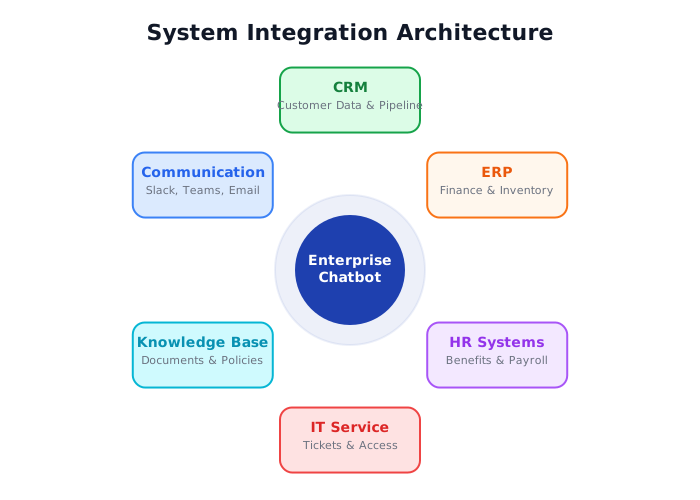
From Information to Action
The evolution we are seeing in 2026 is the move from informational bots to action-oriented agents. Early iterations of business chatbots were successful at deflecting easy questions, but they often frustrated users when the request required doing something in a system.
Modern enterprise architecture focuses on task completion rates rather than just deflection rates. It is not enough to tell a user how to reset their password; the bot must be able to trigger the reset link and verify the user's identity within the chat window. This shift reduces friction and creates a measurable return on investment by removing manual steps from human workflows.
Enterprise, Midmarket, and Small Business: The Core Differences
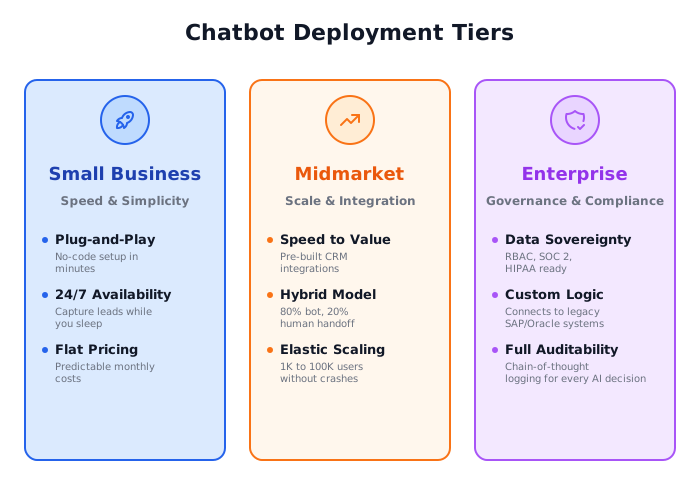
When we analyze the market in 2026, we see three distinct categories of deployment. These tiers dictate the technical requirements, the implementation timeline, and the team needed to manage the AI.
Enterprise Chatbots
At this level, the primary challenges are governance, integration, and volume. Large organizations often manage millions of data points across fragmented legacy systems-some cloud-based, some on-premise mainframes. An enterprise chatbot must act as a unifying layer that connects these disparate sources without exposing security vulnerabilities.
A typical enterprise deployment focuses on these specific priorities:
- Data Sovereignty & RBAC: Large companies require strict Role-Based Access Control (RBAC). The bot must know that a manager in London has different data access rights than a contractor in New York.
- Custom Orchestration: These bots rarely operate out of the box. They require custom middleware to speak to proprietary ERPs (like SAP or Oracle) that have been heavily modified over decades.
- Auditability: Every decision the AI makes needs to be logged. If a bot approves a loan application or denies an insurance claim, there must be a traceable "chain of thought" for regulatory auditors.
Midmarket Chatbots
Midmarket companies usually sit in the "sweet spot" of agility. They have complex needs but generally lack the twenty years of technical debt that slows down Global 2000 companies. Their focus is often on rapid scaling and reducing operational overhead.
These deployments strike a balance between power and speed:
- Speed to Value: They prioritize platforms with pre-built integrations for modern stacks (like HubSpot, Salesforce, or Zendesk) rather than building custom API connectors.
- Hybrid Models: Midmarket companies often use a "human-in-the-loop" approach more aggressively, where the bot handles 80% of traffic and seamlessly hands off high-value accounts to sales teams.
- Scalability: The architecture must be able to handle a spike from 1,000 to 100,000 users without crashing, as these companies are often in high-growth phases.
Small Business Chatbots
For smaller entities, the goal is utility and low friction. These businesses rarely have a dedicated developer team, so the solution must be "no-code" and low maintenance.
The focus here is almost entirely on removing manual labor:
- Plug-and-Play: Installation often takes minutes, utilizing platform-native apps (like a Shopify plugin) rather than custom development.
- Availability: The main value add is 24/7 presence. It captures leads or answers basic questions when the business owner is asleep.
- Cost Predictability: Pricing is usually flat-rate or per-seat, avoiding the consumption-based token pricing that can fluctuate wildly in enterprise models.
High-Impact Use Cases for 2026
While the technology can technically "do anything," successful deployments cluster around areas where high volume meets repetitive complexity. In 2026, we are seeing a shift away from generic "digital assistants" toward specialized agents that own specific business outcomes.
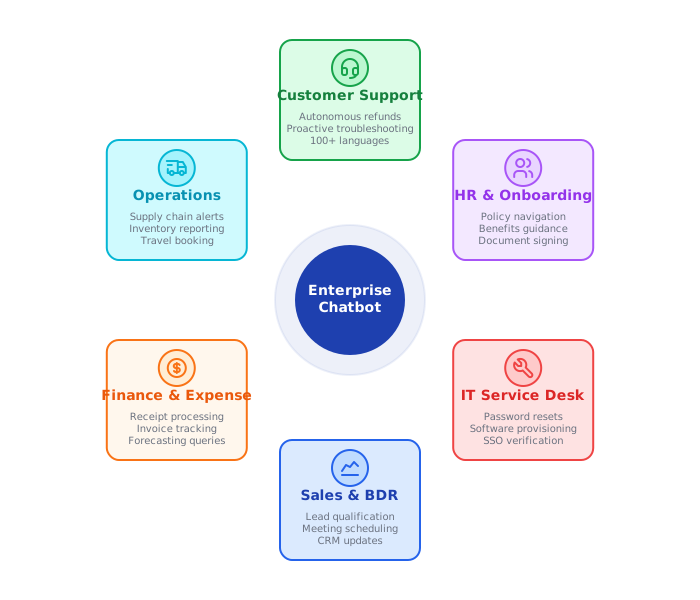
Organizations that deploy agents with a narrow, deep focus tend to see faster ROI than those attempting to build a generalist bot that knows a little bit about everything.
Customer Support and Experience (CX)
This remains the most dominant use case, but the metrics have changed. We have moved past "containment rate" (keeping people away from humans) to "resolution rate" (actually fixing the problem). Modern CX bots function as Tier 1 agents with write-access to backend systems.
Effective CX bots handle end-to-end workflows rather than just answering questions:
- Autonomous Refunds: Instead of citing a refund policy, the bot checks the user's purchase history, validates the return window, generates a shipping label, and initiates the bank transfer.
- Proactive Troubleshooting: Connected to IoT devices or software logs, bots can reach out to users before they report an issue. For example, "I noticed your login failed three times. Do you need to reset your password?"
- Multilingual Localization: Global enterprises use bots to provide native-level support in 100+ languages without hiring local teams for every region.
Internal Operations: HR and IT
Often overlooked, internal-facing chatbots frequently offer the highest ROI because they impact employee productivity directly. When employees spend hours searching for benefits documents or waiting for IT tickets, the company loses money.
An internal "Concierge" bot centralizes institutional knowledge:
- IT Service Management: The most common request in IT is password resets or software provisioning. Bots can handle these via API, verifying identity through SSO (Single Sign-On) and executing the fix in seconds.
- HR Onboarding: New hires often have dozens of questions about payroll, holidays, and benefits. A bot provides a safe, anonymous space to ask "stupid questions" and guides them through document signing processes.
- Policy Navigation: Instead of reading a 40-page PDF to find the bereavement policy, an employee asks the bot, which retrieves the specific clause and summarizes the necessary steps to take.
Sales and Lead Generation
Speed is the primary currency in sales. Data consistently shows that responding to a lead within five minutes increases conversion probability significantly. Enterprise chatbots ensure that no lead sits in a "contact us" void.
These bots act as Digital Business Development Reps (BDRs):
- Dynamic Qualification: The bot asks qualifying questions based on the user's behavior. If a user is on the "Enterprise Pricing" page, the bot asks about team size and budget. If they are on the "Blog," it offers a newsletter signup.
- Meeting Scheduling: Once a lead is qualified, the bot checks the calendar of the appropriate account executive (based on territory or industry) and books a meeting directly in the chat.
- Pipeline Hygiene: After the interaction, the bot updates the CRM with the transcript and key data points, ensuring the sales team has context before the first call.
Finance and Procurement
Financial use cases require high accuracy and low latency. Hallucinations here are unacceptable, so these bots rely heavily on deterministic rules rather than creative generation.
They function as gatekeepers and analysts:
- Expense Management: Employees upload receipts to a chat window; the bot OCRs (scans) the data, categorizes the expense, checks it against company policy limits, and submits it for approval.
- Invoice Processing: Bots can chase down unpaid invoices by automatically sending reminders to vendors or customers and answering questions about payment terms.
- Forecasting Queries: Executives can use natural language to query financial data, asking, "What was our burn rate in Q3 compared to Q2?" without needing to open a complex dashboard.
The Strategic Value Proposition
Why are CIOs and CTOs prioritizing this technology in their 2026 budgets? It is rarely just about "cutting headcount." The modern business case for enterprise chatbots centers on infrastructure stability, data intelligence, and scalability.
When implemented correctly, these systems provide structural advantages that go beyond simple cost savings.
1. Elastic Scalability
Human support teams are inelastic. If your traffic spikes by 300% due to a product launch or a service outage, you cannot hire and train 50 new agents overnight. Conversely, during quiet periods, you cannot simply pause salaries.
Enterprise chatbots offer infinite elasticity. They handle one concurrent conversation as easily as they handle ten thousand. This stabilizes the customer experience during crises. When a service goes down, the bot can instantly broadcast the status to thousands of users simultaneously, preventing the phone lines from being overwhelmed and allowing the human team to focus on fixing the technical issue.
2. The "Glass Box" of Customer Intent
Traditional analytics tell you what users did (e.g., "User visited pricing page," "User bounced"). They rarely tell you why.
Chatbots generate transcripts-rich, unstructured data that contains the literal voice of the customer. By analyzing these conversations at scale, companies gain access to a feedback loop that was previously invisible.
- Product Feedback: You might discover that 40% of users asking about "Feature X" are actually confused by how it is labeled in the UI.
- Market Intelligence: You can detect improved competitor offers if users start asking, "Why does X Company offer this for cheaper?"
3. Modernizing Legacy Infrastructure
Many enterprises run on "unmovable" legacy systems-ancient mainframes or databases that are too risky to replace but too painful to use.
A chatbot acts as a modern interface layer on top of this aging technology. instead of training new employees to navigate a green-screen terminal or a clunky internal portal from 2010, they can simply ask the bot to "Update the shipping address for Order #12345." The bot handles the complex API calls to the legacy system in the background. This extends the life of legacy investments while giving employees a modern, efficient user experience.
4. Standardization of Compliance
In industries like insurance, banking, and telecommunications, what an agent says is legally binding. Human agents, regardless of training, vary in their responses. They might forget a disclaimer or misquote a policy during a stressful call.
An AI agent is deterministic in its compliance. It never forgets to read the terms and conditions, and it never improvises on regulatory policy. This creates a standardized layer of service where the company can guarantee that every customer received the exact correct information required by law, reducing liability risk.
5. Asynchronous Efficiency
We often underestimate the time lost to "context switching" and waiting. In an internal context, an employee might email HR about a leave policy and wait two days for a reply. That is a two-day open loop in their mind.
Chatbots close these loops instantly. By resolving low-level queries asynchronously, the organization moves faster. Salespeople get pricing approvals instantly; developers get server access instantly; customers get refunds instantly. The velocity of business increases when you remove the "waiting for a human to read their email" step from the workflow.
The Deployment Roadmap: From Concept to Scale
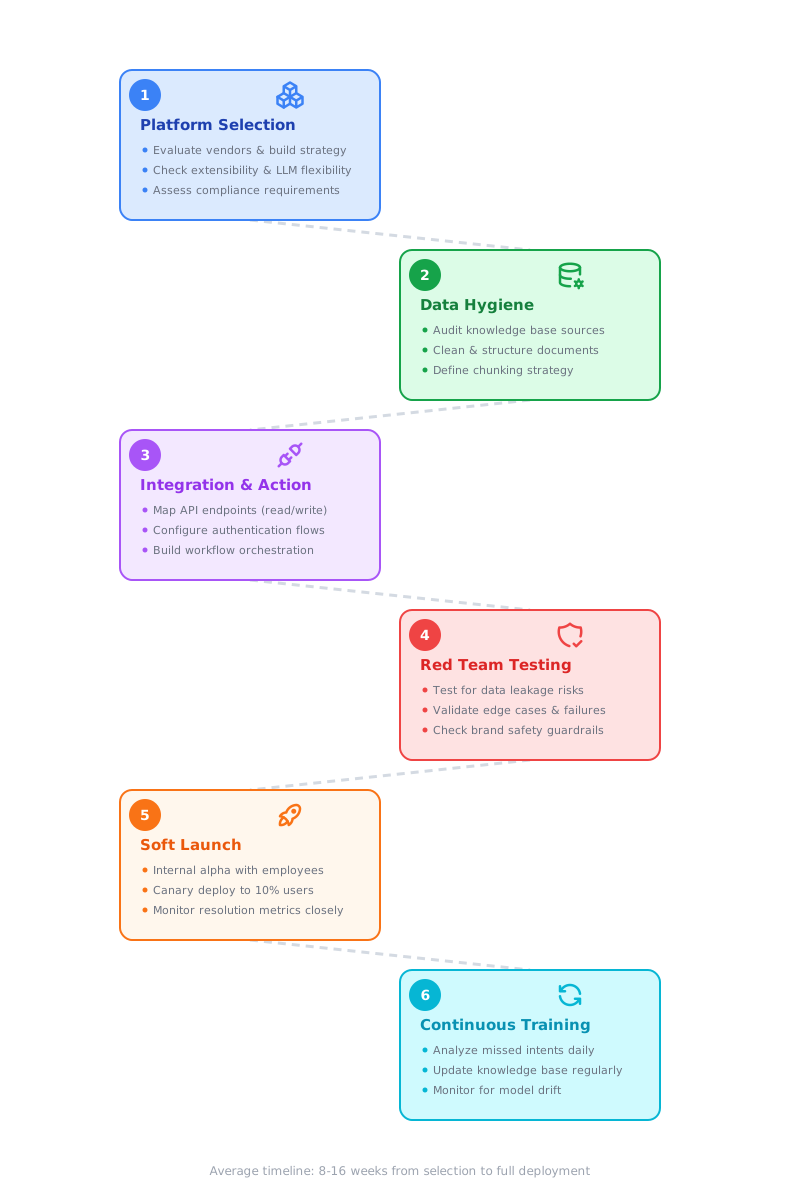
Building an enterprise chatbot is rarely a coding challenge; it is an integration challenge. The code for a basic chatbot is simple. The architecture required to make it reliable, secure, and useful at scale is complex.
We have seen hundreds of deployments, and the successful ones almost always follow a structured, phased approach rather than a "Big Bang" launch.
Phase 1: Platform Selection and Architecture
The "Build vs. Buy" debate has largely settled. Most enterprises now opt for a "Buy and Build" strategy-licensing a robust platform (like Botpress, Microsoft Copilot Studio, or others) and building custom logic on top of it. Building a proprietary NLP engine from scratch in 2026 is rarely cost-effective.
Key Decision Factors:
- Extensibility: Can you write custom code (JavaScript/Python) within the platform? Low-code is great for speed, but you will eventually hit a wall where you need custom logic.
- Vendor Lock-in: Does the platform support open standards? Can you export your conversation flows?
- LLM Agnosticism: This is vital. You do not want to be tied to a single AI model. The best platforms allow you to swap models (e.g., moving from GPT-5 to Claude or a proprietary Llama model) as technology improves or pricing shifts.
Phase 2: Data Hygiene and Knowledge Engineering
Your chatbot is only as intelligent as the data it can access. If you point an AI at a folder full of outdated PDFs, conflicting policies, and draft documents, it will produce confident but incorrect answers. This is often called the "Garbage In, Garbage Out" problem.
The Preparation Checklist:
- Audit Your Knowledge Base: Delete or archive old files. If there are two documents titled "2024 Remote Work Policy" and "2026 Remote Work Policy," the AI might get confused.
- Chunking Strategy: AI reads data in segments. You need to format your documents so they are easily "readable" by the machine. Bullet points and clear headings help the AI understand hierarchy better than dense walls of text.
- Human-in-the-Loop Review: Before connecting the data, have domain experts review the source material for ambiguity.
Phase 3: Integration and Action
This is where the bot becomes useful. You need to map out the API endpoints the bot will need to access.
- Read Access: What does the bot need to know? (e.g., Order Status, Account Balance, Flight Time).
- Write Access: What is the bot allowed to do? (e.g., Update Address, Cancel Order, Book Meeting).
Technical Tip: Start with "Read" access. It is safer. Once the bot is proven stable, introduce "Write" capabilities. A bot that can accidentally delete data is a high-risk variable during the early testing phases.
Phase 4: Red Teaming and Stress Testing
Before you let customers talk to the bot, you need to try to break it. "Red Teaming" involves hiring internal or external testers to act as adversaries.
What they test for:
- Brand Risk: Can they make the bot say something offensive or politically charged?
- Data Leakage: Can they trick the bot into revealing another user's data?
- Edge Cases: What happens if a user types gibberish, spams emojis, or switches languages mid-sentence?
Phase 5: The "Soft Launch" (Canary Deployment)
Never launch to 100% of your user base on Day 1.
- Internal Alpha: Let your employees use the bot first. They are more forgiving and can provide feedback on terminology.
- 10% Rollout: Deploy the bot on a specific page or to a specific region. Monitor the "Resolution Rate" closely.
- Full Scale: Once metrics are stable, open the floodgates.
Phase 6: Continuous Training (The Feedback Loop)
Launch is not the finish line; it is the starting line. The day after launch, you will have thousands of real conversations to analyze.
- Missed Intents: You will discover users asking for things you never anticipated.
- Frustration Signals: Look for conversations where users ask for a "human" or use negative sentiment. These are learning opportunities to patch the bot's logic.
- Drift: Over time, your products and policies change. You must have a process to update the bot’s knowledge base, or it will slowly become obsolete (Model Drift).
Future-Proofing: What Comes Next?
As we look toward the latter half of 2026 and beyond, the definition of a "chatbot" continues to dissolve. We are moving toward Agentic Interfaces.
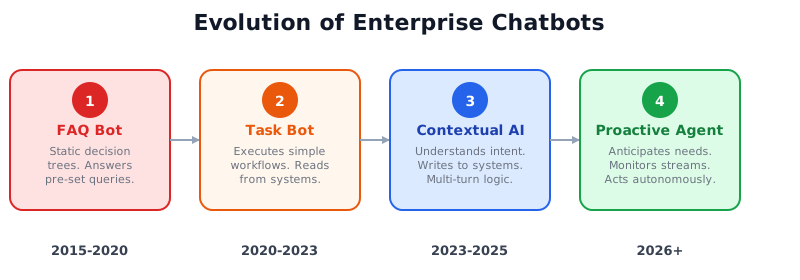
Currently, you go to a chatbot to ask a question. In the near future, the AI will likely come to you. We are seeing early prototypes of "Proactive Agents" that monitor business streams and intervene without being asked.
Imagine a supply chain bot that notices a weather event in the Pacific, calculates the potential delay for a shipment, and proactively messages the logistics manager: "Typhoon detected near the shipping route. I recommend re-routing Order #998 to the secondary distribution center. Shall I proceed?"
This shift from Reactive (waiting for input) to Proactive (anticipating needs) represents the next great leap in enterprise value. The organizations that build the infrastructure today-cleaning their data, securing their APIs, and establishing governance-will be the ones ready to turn that switch on when the technology matures.
Frequently Asked Questions

Connect an agent to any web app
No signup, runs in your browser
Ready to let your AI agent act on the live web?
Headless browsers give your agent a copy of the web. Webfuse gives it the session your user is actually in — over MCP, with no install.
- No credit card
- Free forever plan
- Quick setup
Related Articles