Agentic coding describes AI systems, or agents, that autonomously plan, write, test, debug, and deploy code with minimal human direction. This approach differs from traditional AI coding assistants, which function more like autocomplete or conversational partners. Agentic systems operate in persistent loops, breaking down high-level objectives into executable steps. They use a suite of tools-such as the file system, terminal, and version control-to explore codebases, recover from errors, and manage complex, multi-step tasks.
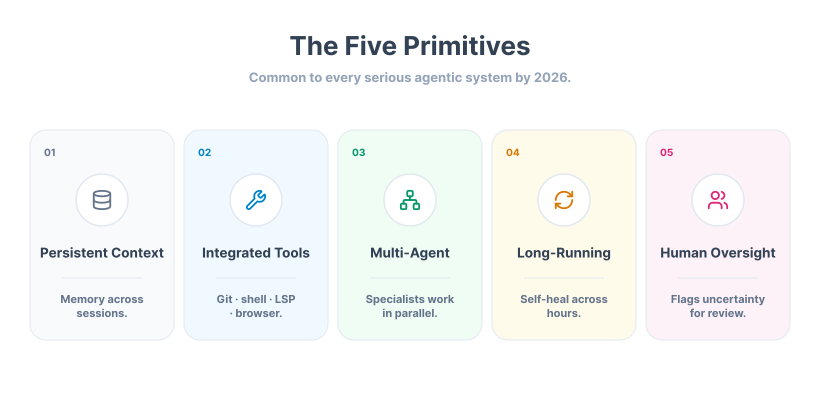
This method is distinct from "vibe coding," which involves quick, iterative prompting for exploration or demos. Agentic coding is a more autonomous, goal-oriented process, analogous to delegating a complete task to a capable junior engineer who works independently but under supervision. The focus is on autonomy, persistence, and the orchestration of complex software development workflows.
Core Architecture and Capabilities
By 2026, most agentic coding systems have converged on a set of common architectural primitives and capabilities. This standardization allows for more predictable interactions and integrations across different platforms.
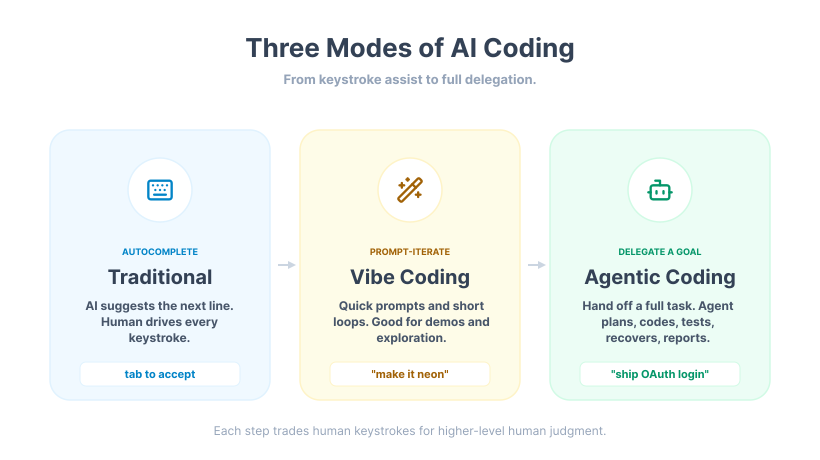
- Persistent Project Context: Agents maintain long-term memory of a project's goals, conventions, and architecture through dedicated files (e.g.,
CLAUDE.md,AGENTS.md). This allows them to retain context across sessions that can last for days or weeks. - Integrated Tool Use: Agents are equipped with a digital toolkit that mirrors a human developer's environment. This includes Git for version control, shell access for command-line operations, automated testing frameworks, package managers, web browsers for research, and LSP integration for code intelligence.
- Multi-Agent Orchestration: Complex problems are often solved by a team of specialized sub-agents working in concert. For example, a planner agent might decompose a high-level goal, which is then distributed to separate coding, testing, and reviewing agents that can work in parallel.
- Long-Running Execution: Systems are designed for sessions that last from minutes to several days. These long-running tasks feature checkpointing and self-healing mechanisms, allowing an agent to recover from transient failures and resume its work without human intervention.
- Human-AI Collaboration: The workflow is designed as a partnership. Agents flag uncertainties and request human input for ambiguous requirements or high-stakes decisions, such as deploying to production. This shifts the developer's role from writing code to providing oversight, architectural guidance, and final approval.
Performance and Benchmarks
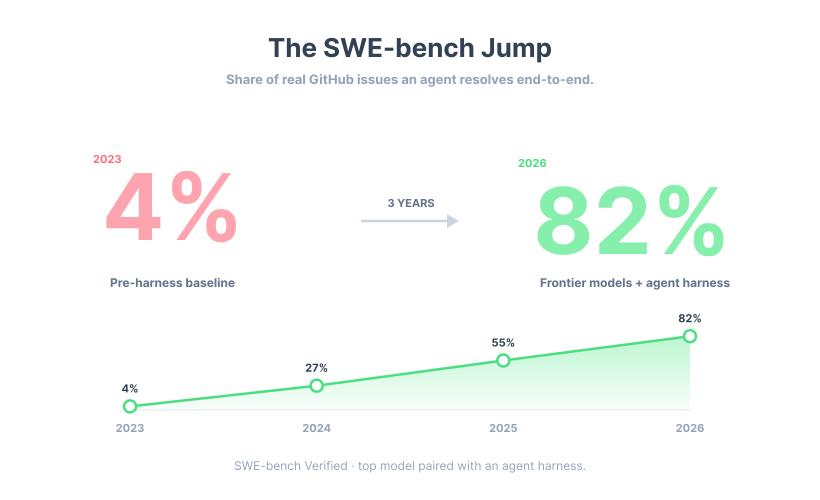
The performance of these systems is measured using realistic coding benchmarks derived from open-source GitHub issues. These tests evaluate an agent's ability to resolve genuine software problems from start to finish.
The SWE-bench Verified benchmark has become a standard for evaluation, and the results from 2026 show major progress. Top models like Claude Opus and GPT-5.x, when paired with a suitable agent harness, achieve success rates exceeding 70-90% on the standard benchmark, a large increase from just ~4% in 2023. Performance on more difficult "pro" variants of the benchmark is lower but still impressive, typically in the 50-77% range. These figures show that the agent's scaffolding, or "harness," is as important as the underlying language model for achieving high scores.
Agents show strong performance in well-defined tasks like bug fixes, implementing new features from detailed specifications, dependency migrations, test generation, and code refactoring. They continue to face difficulties with creating entirely novel system architecture or acting on highly ambiguous requirements without specific human direction.
Productivity Impact
The adoption of agentic coding has led to measurable gains in software development productivity. Organizations that have integrated these tools report major accelerations in their development lifecycles and sizeable increases in output.
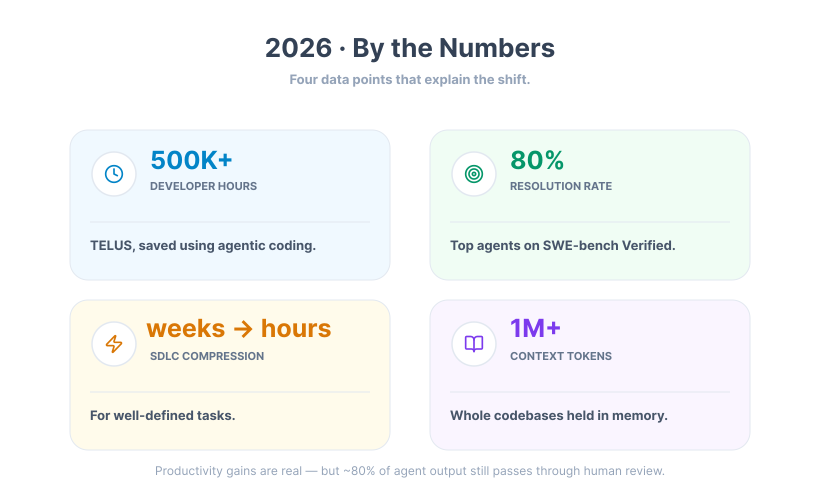
For example, TELUS reported saving over 500,000 developer hours by using these systems for a variety of coding tasks. The software development life cycle (SDLC) for many common projects is now compressed from weeks into hours or days. Developer onboarding to unfamiliar codebases, a process that once took weeks of study, can now be completed in hours as agents provide guided exploration and contextual summaries. This has prompted a change in the developer's role from a primary coder to an orchestrator of AI agents.
Leading Tools and Agents in 2026
The market for agentic tools is competitive, with several platforms emerging as leaders based on performance, workflow integration, and user adoption. Rankings differ by source, but the following tools are consistently recognized in the 2026 landscape.
- OpenAI Codex: Often cited for its overall execution capabilities, it features powerful GPT-5.x models, multi-agent worktrees for parallel tasks, and a context system based on
AGENTS.mdfiles. It is highly effective for code generation, automated reviews, and parallelized development work. - Claude Code (Anthropic): Recognized for its elite reasoning and planning capabilities, supported by a very large context window of over 1 million tokens. Its strengths lie in handling complex refactors and navigating large, intricate codebases.
- Cursor: An AI-native fork of VS Code that has gained wide adoption. Its hybrid model combines local IDE responsiveness with cloud-based agents for long-running tasks and parallel sub-agent execution. The company has achieved a sizeable market presence, with reported annual recurring revenue near $2 billion.
- Devin (Cognition Labs): Known for its high degree of autonomy, this agent can handle tasks end-to-end-from planning and coding to testing and deployment-within a sandboxed environment. It is frequently used by large firms like Goldman Sachs for enterprise migrations and technical debt reduction.
- GitHub Copilot: Offers the broadest ecosystem integration, deeply embedded within the developer workflow. Its features include asynchronous agents that can convert GitHub issues directly into pull requests using a variety of underlying models.
- Other Tools: Other notable tools in the space include Gemini CLI (offering a strong free tier and large context), Windsurf (specialized for extremely large codebases), Replit Agent (focused on rapid prototyping), OpenCode (a flexible open-source option), and Augment Code (designed for massive monorepos).
Many of these platforms support multi-model backends, allowing development teams to choose the most suitable AI for a given task or budget.
Your coding agent can write the change. It cannot see it run.
Give it a live browser session over MCP.
Key Trends for 2026
Analysis from industry reports points to several major trends shaping the future of agentic coding. These trends affect everything from the software development lifecycle to the very definition of an engineering role.
Foundation
The core change is the transformation of the SDLC. Tactical, line-by-line coding is increasingly handled by AI, freeing humans to concentrate on strategy, system architecture, and high-level orchestration. This leads to an evolution of the engineering role into one resembling an AI team manager, where the primary job is to define goals and review outcomes.
Capabilities
The field has moved well beyond single-agent systems. The most important capability trends include:
- Single to Multi-Agent Teams: Systems now deploy specialized agents that work in parallel on different parts of a problem, mimicking a human software team.
- Long-Running Agents: Agents are capable of executing tasks that last for days or even weeks, such as building entire features or systems from a high-level specification.
- Intelligent Oversight: Agents are programmed to self-flag uncertainties, and AI-powered code reviewers are used to check the output of other AI agents, creating a layered quality control system.
Impacts
The economic and social effects of this technology are becoming apparent. The higher output volume makes smaller, previously unfeasible projects economically viable and allows organizations to address long-standing technical debt more efficiently. The autonomy of agents also creates new security and dual-use risks, which necessitates the development of new governance models to manage agents that can act independently.
Challenges and Limitations
Despite rapid progress, agentic systems still face important limitations and present new challenges. Full delegation of tasks remains uncommon, with human review still required for a high percentage of work, often estimated between 80-100% depending on the task's complexity.
- Reliability and Hallucinations: Agents can still produce incorrect or nonsensical code, especially in novel or highly complex scenarios. Human oversight remains a necessary backstop to catch these errors before they reach production.
- Cost and Security: The computational cost of running these agents, combined with context window limitations, can be a barrier. Giving agents access to production tools, repositories, and terminals also introduces security vulnerabilities that must be carefully managed.
- Code Maintainability: The high speed of code generation can lead to an increase in technical debt if not properly managed. Human architectural oversight is key to ensuring the generated code is clean, efficient, and maintainable over the long term.
- Job Market Transformation: Routine coding tasks are being automated, leading to a major shift in job roles towards orchestration, architecture, and system design. This transformation requires new skills and creates new opportunities while displacing some existing work.
Frequently Asked Questions

Connect an agent to any web app
No signup, runs in your browser
Ready to let your AI agent act on the live web?
Headless browsers give your agent a copy of the web. Webfuse gives it the session your user is actually in — over MCP, with no install.
- No credit card
- Free forever plan
- Quick setup
Related Articles