
- BYO TTS - ElevenLabs, Cartesia Sonic, Play.ht, Deepgram Aura, Azure, LMNT, OpenAI, plus curated Vapi Voices
- When you select ElevenLabs as the TTS, you inherit ElevenLabs quality directly
- Adds ~50–100ms of orchestration overhead vs a native stack
- Voice cloning quality depends entirely on the TTS provider you pick
Voice AI Comparison
Vapi vs ElevenLabs
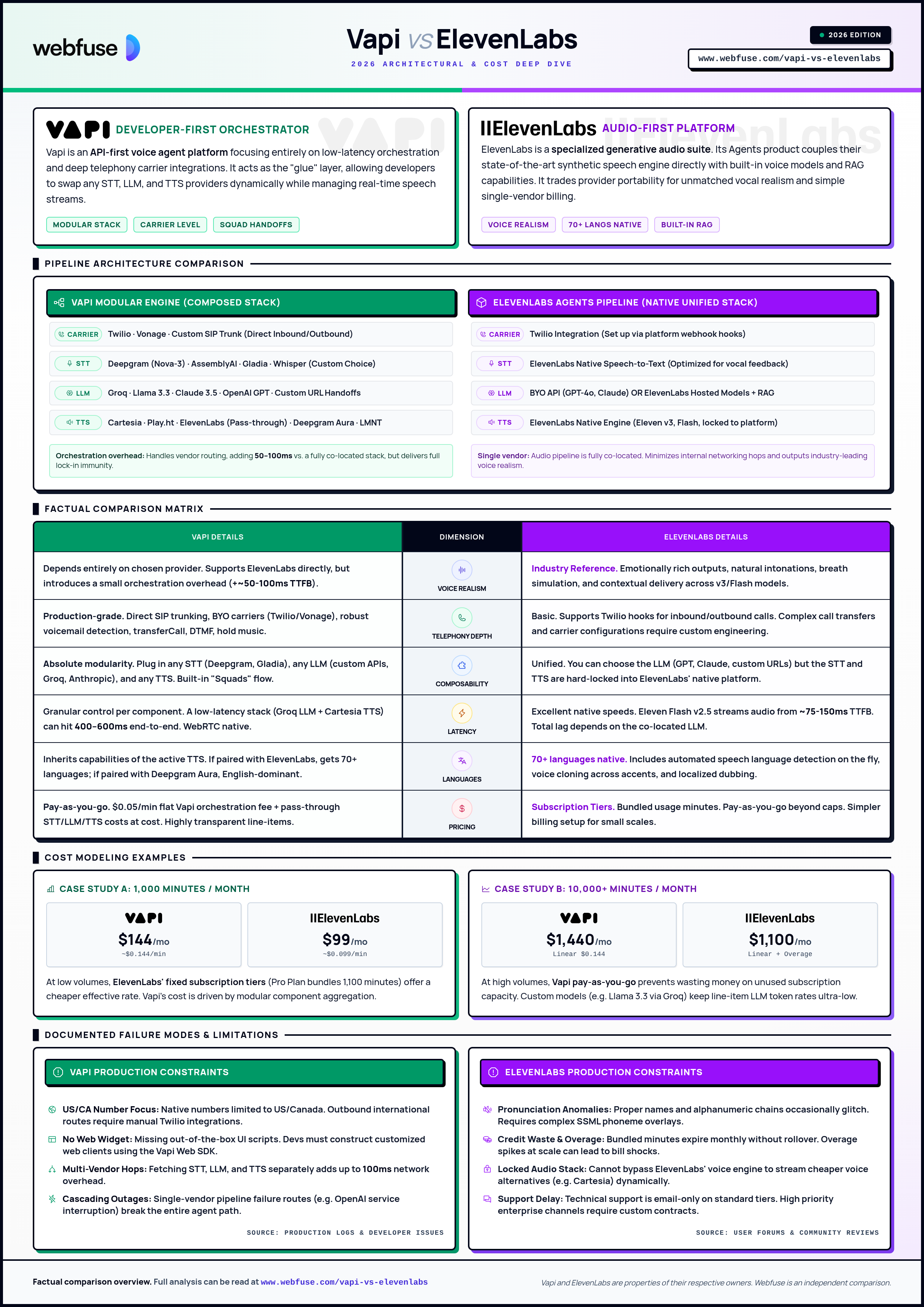
Vapi is a developer-first orchestration platform built for telephony, while ElevenLabs is a voice synthesis platform built around the most lifelike speech output available. Across six dimensions, they score 49 and 48 out of 60 - the right pick comes down to one question: are you building call infrastructure or optimizing for voice realism.

Comparison cheat sheet (click to open)
Quick Quiz
Not sure which to pick?
Answer five questions and we'll tell you which platform fits - or whether you should use both.
// Your setup
Vapi AI
Your answers point at developer control, telephony depth, or provider flexibility - and that's exactly what Vapi was built for. You'll trade a small bit of voice realism for a lot more control over the stack.
The TL;DR
Two products. Two sweet spots.
Decide by what dominates your use case - the score is close, the positioning isn't.
Pick Vapi if...
- Phone is the primary channel and you need mature SIP/Twilio depth
- You want full control of the STT + LLM + TTS stack
- Engineering team that wants line-item pricing and per-leg latency tuning
- Multi-assistant orchestration (Squads) with handoff between specialised agents
- Custom or fine-tuned LLM endpoints
Pick ElevenLabs if...
- Voice realism is the headline product feature
- You need 30+ languages with a single config
- Voice cloning is core to the user experience
- Creator-friendly UI matters - not everyone on your team is a developer
- You want fewer moving parts: one vendor, one bill, one stack
Head-to-head
The 6 Comparison Rounds
Six categories, scored head-to-head. Click any round to see how each platform performs and why.
Voice Quality
ElevenLabs sets the bar for synthetic voice - emotion, intonation, breath. Vapi routinely uses ElevenLabs as one of its TTS providers, so picking ElevenLabs as Vapi's voice closes the gap (with a small orchestration cost).
- Eleven v3 - expressive, emotionally rich; Flash & Turbo for low-latency production
- 10,000+ pre-built voices + Instant + Professional voice cloning
- Voice Design - generate a voice from a text description
- Emotional awareness, intonation, breathing, contextual delivery
Voice Quality
ElevenLabs sets the bar for synthetic voice - emotion, intonation, breath. Vapi routinely uses ElevenLabs as one of its TTS providers, so picking ElevenLabs as Vapi's voice closes the gap (with a small orchestration cost).
- BYO TTS - ElevenLabs, Cartesia Sonic, Play.ht, Deepgram Aura, Azure, LMNT, OpenAI, plus curated Vapi Voices
- When you select ElevenLabs as the TTS, you inherit ElevenLabs quality directly
- Adds ~50–100ms of orchestration overhead vs a native stack
- Voice cloning quality depends entirely on the TTS provider you pick
- Eleven v3 - expressive, emotionally rich; Flash & Turbo for low-latency production
- 10,000+ pre-built voices + Instant + Professional voice cloning
- Voice Design - generate a voice from a text description
- Emotional awareness, intonation, breathing, contextual delivery
Final Tally
Within 2 points - your priorities decide.
Here's how the scores add up across all six categories.
Vapi
// Developer-first orchestrator
Category Ratings
- Voice Quality7/10
- Telephony9/10
- Flexibility10/10
- Latency9/10
- Languages6/10
- Pricing8/10
ElevenLabs
// Best-in-class voice + integrated agents
Category Ratings
- Voice Quality10/10
- Telephony6/10
- Flexibility7/10
- Latency8/10
- Languages10/10
- Pricing7/10
Pricing - full picture
Every tier, side by side.
Both platforms charge by the minute, but the structures are different. Vapi keeps it simple with pay-as-you-go plus provider passthrough. ElevenLabs ladders through subscription tiers with bundled minutes. Pricing as of May 2026 - check vendor pages for current rates.
- Pay-as-you-go platform fee with no monthly contracts
- Concurrency: 10 lines included; scale to custom limits
- Complete freedom to swap STT, LLM, and TTS per call
- 250 to 3,600 conversational minutes bundled monthly
- Professional voice cloning and usage-based billing
- Predictable monthly billing for fixed production needs
// Real-world cost example
Worked example - 1,000-minute / month support agent
Vapi (typical tuned stack)
$0.05 platform + Deepgram STT $0.01 + GPT-4o-mini $0.02 + Cartesia TTS $0.05 + Twilio $0.014
≈ $144 / mo
$0.144 / min
ElevenLabs Pro plan
1,000 min sits inside Pro plan (1,100 min bundle)
$99 / mo
$0.099 / min effective
ElevenLabs Business plan (at full use)
$1,320 covers 13,750 min - heavy overcapacity at 1k/mo
$1,320 / mo
Only worth it ≥ ~8k min/mo
At 1,000 min/month ElevenLabs's Pro plan is the cheapest path on paper. Above ~10,000 min/month, Vapi's pay-as-you-go usually wins because you avoid bundled overcapacity. Real-world spend depends on chosen voices, LLM tokens, and carrier fees - model both with your own volume.
Where each one breaks
The honest stuff vendor pages skip.
Every comparison page shows strengths. None show where each platform actually breaks. Below are documented failure modes from production users, support threads, G2 reviews, and the platforms' own changelogs. Knowing these in advance is worth more than another bullet list of features.
Phone numbers limited to US / Canada natively
Buying numbers in other countries requires importing via Twilio or Vonage. If you launch internationally on day one, factor this in.
No drop-in web widget
There is no embeddable script tag for a web chat / call widget. You integrate programmatically with the Vapi Web SDK. Not blocking, but slower to ship a marketing-site demo.
Orchestration adds latency vs native stacks
Routing between STT, LLM, and TTS providers adds roughly 50–100 ms of overhead compared to a tightly integrated single-vendor stack.
No batch outbound / mass campaigns
There is no built-in outbound campaign tool with retry logic, throttling, or list import. Heavy outbound users wire this together themselves.
Provider outages cascade
If Deepgram, OpenAI, or your chosen TTS provider goes down, your Vapi agent goes with it. Native stacks have a smaller attack surface for outages.
Pronunciation glitches on proper names
Non-English names and unusual alphanumerics ("Siobhan", "Worcestershire", licence plates) occasionally come out wrong. Workaround is SSML phoneme hints, which is fiddly.
Credit-based pricing can shock at scale
Bundled minutes do not roll over month to month. Heavy usage months trip overage charges; light months leave credits unused. Predictable on average, surprising on the edges.
Occasional audio artifacts
Users report rare whispering noises, abrupt accent shifts mid-sentence, or volume drops on long outputs. Reportedly improved in v3 / Flash but not zero.
No live chat support
Support is email-only. Responsive on average, but urgent production issues can stall waiting for a reply.
TTS is locked - you cannot swap it out
ElevenLabs voice IS the platform. If a particular voice does not fit your brand or pronounces a key term wrong, you cannot just route to a different TTS provider mid-stack.
Both lists are sourced from documented user feedback, support threads, and platform changelogs as of May 2026. Both teams ship fast - items here can move to the strengths column in any given quarter.
Use Case Picks
Which one wins for your use case?
Six common scenarios with a defended pick - including the one where you're better off using both.
Phone support agent
Mature telephony, voicemail detection, transferCall, DTMF, multi-region.
Premium consumer voice product
TTS realism + voice cloning are the heard product.
Multilingual EU / LATAM rollout
70+ languages native; auto language detection; localization tooling.
Custom LLM + lowest $/min
Custom-LLM URL + Groq + Cartesia = cheapest sub-second stack.
Creator-led content & dubbing
ElevenCreative covers dubbing, sound effects, music, voice cloning.
Production phone agent (most teams)
Vapi orchestration + telephony, ElevenLabs as the TTS - the common production stack.
FAQ
Questions people actually ask
The honest answers - drawn from real product positioning, not press releases.
What is the main difference between Vapi and ElevenLabs Agents?
Vapi is a developer-first orchestration platform built primarily for telephony - you pick the STT, LLM, and TTS providers and Vapi wires them together. ElevenLabs is an audio platform built around best-in-class TTS, with conversational agents as one of its products. They overlap, but they optimise for different things.
Which one has better voice quality?
ElevenLabs, decisively. It is widely considered the industry reference for realistic synthetic voice, with strong emotion, multilingual coverage, and voice cloning. Vapi often uses ElevenLabs as its TTS provider - so picking ElevenLabs voice inside Vapi closes most of the gap.
Can I use ElevenLabs voices inside Vapi?
Yes - this is actually the most common production setup. You configure `voice.provider = "11labs"` in your Vapi assistant and pass the ElevenLabs voice ID. You get Vapi telephony and orchestration with ElevenLabs voice quality. You pay both a Vapi platform fee and ElevenLabs TTS rates.
Is Vapi cheaper than ElevenLabs Agents?
It depends on stack. Vapi charges $0.05/min platform plus pass-through to STT/LLM/TTS providers, totalling $0.15–$0.35/min in practice. ElevenLabs Agents bundles into subscription tiers - typical effective rates are $0.08–$0.30/min. At small scale ElevenLabs is often simpler; at high volume a tuned Vapi stack (Groq LLM, Cartesia TTS) is usually cheaper.
Can ElevenLabs Agents do phone calls?
Yes, via Twilio integration. But Vapi has noticeably deeper telephony: BYO SIP, mature voicemail detection, transferCall, Vonage support, $10/line concurrency, and multi-region deployment. If phone is the primary channel, Vapi has the edge.
Which one supports more languages?
ElevenLabs Agents - 70+ languages natively with multilingual voice cloning. Vapi depends on the TTS provider you pick; selecting ElevenLabs inside Vapi gives you the same language coverage with some orchestration overhead.
Which is easier to use for non-developers?
ElevenLabs. The platform is built around an integrated UI with strong creator tooling (Studio, dubbing, sound effects, music generation). Vapi is API-first and assumes engineering resources to wire up providers, write tools, and tune latency.
How do they compare on latency?
Both are production-ready in the 500–800ms p50 range. Vapi can be tuned lower with Groq + Cartesia (~400ms in best case). ElevenLabs Flash TTS streams from ~75–300ms TTFB and benefits from a tighter native stack. The realistic answer for most stacks: comparable.
Are they both enterprise-ready?
Yes. Both offer HIPAA, SOC 2, SSO, RBAC, enterprise SLAs, and audit logging. Vapi additionally offers zero-data-retention add-ons; ElevenLabs offers FDE and provenance watermarking on enterprise tiers. Pick by use case fit, not compliance.
Can I run either voice agent on a website I do not own?
Not natively. Both deploy via web SDKs that you embed into your own application. To put a Vapi or ElevenLabs agent onto a live third-party website without modifying its source, you need a web-augmentation layer like Webfuse that injects the agent through a proxied session.