Retell Winner
9/10- Ultra-realistic voices tuned for phone automation
- Advanced turn-taking with interruption handling out of the box
- Natural barge-in and back-channeling without extra config
- Voice quality is consistent across the default stack
Voice AI Comparison
Retell is a managed, voice-first platform built to ship a compliant production call center quickly, while Vapi is an API-native orchestrator built for developers who want control over the whole stack. Across six dimensions, they score 51 and 50 out of 60 - the right pick comes down to one question: do you want the fastest path to production or maximum control over the stack.
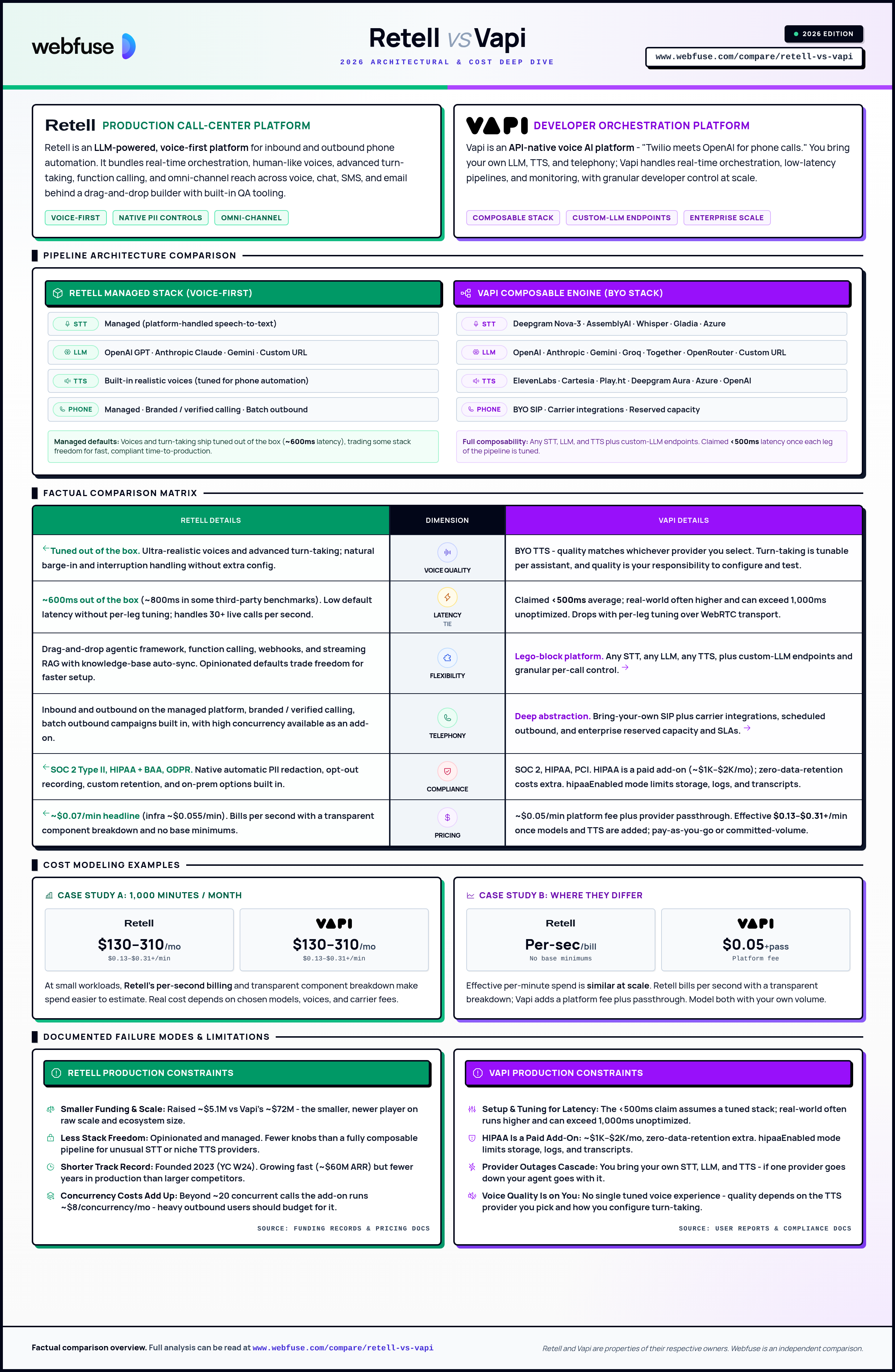
Comparison cheat sheet (click to open)
Quick Quiz
Answer five questions and we'll tell you which platform fits - or whether it's a closer call than you think.

Stack control, custom LLM endpoints, ecosystem, or enterprise scale dominate your priorities - and that is exactly what Vapi was built for. You trade out-of-box simplicity for granular control.
The TL;DR
Decide by what dominates your use case - the score is close, the positioning isn't.
Head-to-head
Six categories, scored head-to-head. Click any round to see how each platform performs and why.
Retell leans on ultra-realistic voices and advanced turn-taking out of the box, so interruptions and barge-in feel natural without tuning. Vapi inherits whatever TTS you pick, so quality depends on the provider you wire in.
Retell leans on ultra-realistic voices and advanced turn-taking out of the box, so interruptions and barge-in feel natural without tuning. Vapi inherits whatever TTS you pick, so quality depends on the provider you wire in.
Final Tally
Here's how the scores add up across all six categories.
// Voice-first, production-ready
// Developer-first orchestrator
Both handle the call. Neither touches the page.
Webfuse acts in the live session.
Pricing - full picture
Both platforms charge by usage, and effective rates land in a similar range once you add models, TTS, and telephony. Retell bills per second with a transparent component breakdown; Vapi charges a platform fee plus provider passthrough. Pricing as of June 2026 - check vendor pages for current rates.
// Real-world cost example
Retell infra ~$0.055/min + LLM tokens + TTS + telephony passthrough
≈ $130 – $310 / mo
$0.13–$0.31+ / min
$0.05 platform + STT + LLM tokens + TTS + telephony passthrough
≈ $130 – $310 / mo
$0.13–$0.31+ / min
Retell bills per second with a transparent component breakdown; Vapi adds a platform fee plus passthrough
Similar at scale
Model with your own volume
Effective per-minute spend is close between the two once you add models, TTS, and telephony. Retell's per-second billing and transparent breakdown make small workloads easier to estimate; Vapi's platform-fee model is simple to reason about at the platform layer. Real spend depends on chosen models, voices, and carrier fees - model both with your own volume.
Where each one breaks
Every comparison page shows strengths. None show where each platform actually breaks. Below are documented failure modes and trade-offs drawn from product behavior, support threads, and the platforms' own docs. Knowing these in advance is worth more than another bullet list of features.
Retell has raised ~$5.1M total versus Vapi's ~$72M. It is capital-efficient and growing fast, but it is the smaller, newer player on raw scale and ecosystem size.
The platform is opinionated and managed. That speeds setup, but you have fewer knobs than a fully composable pipeline if you need an unusual STT or a niche TTS provider.
Founded 2023 (YC W24). Revenue is growing fast (~$60M ARR, up ~650% YoY) but the platform has fewer years in production than larger competitors.
Base concurrency is included up to a point; beyond ~20 concurrent calls the add-on runs ~$8/concurrency/month, which heavy outbound users should budget for.
The ~$0.07/min headline is the voice engine only. LLM, TTS, and telephony are passthrough, so real cost lands at ~$0.13–$0.31+/min depending on the stack.
The <500ms claim assumes a tuned stack. Real-world latency often runs higher and can exceed 1,000ms unoptimized, so hitting low numbers takes per-leg work.
HIPAA costs ~$1K–$2K/month and zero-data-retention is extra. hipaaEnabled mode limits storage, logs, and transcripts, and restricts some features.
Because you bring your own STT, LLM, and TTS, if one provider goes down your agent goes with it. A managed stack has a smaller surface for this.
Vapi does not ship a single tuned voice experience - quality depends entirely on the TTS provider you pick and how you configure turn-taking.
The flexibility that makes Vapi attractive also means more moving parts to wire up, monitor, and maintain than a managed platform.
Both lists are sourced from documented product behavior, support threads, and platform docs as of June 2026. Both teams ship fast - items here can move to the strengths column in any given quarter.
Use Case Picks
Six common scenarios with a defended pick - so you can match the platform to the job at hand.
Fast time-to-production, strong default voice and turn-taking, native QA tooling.
Custom-LLM endpoints, any STT and TTS, granular per-call developer control.
Native PII redaction, BAA available, custom retention, on-prem options.
1B+ calls processed, 1M+ developers, reserved capacity and dedicated engineers.
Voice, chat, SMS, and email plus branded calling and batch outbound in one platform.
Swap any provider per call and tune each leg of the pipeline for cost or latency.
FAQ
The honest answers - drawn from real product positioning, not press releases.
Retell is a managed, voice-first platform built to ship a production call center quickly, with strong default voices, advanced turn-taking, native compliance tooling, and omni-channel reach. Vapi is an API-native orchestrator that gives developers control over the STT, LLM, TTS, and telephony stack. Retell optimizes for fast, compliant time-to-production; Vapi optimizes for control and ecosystem.
Retell has the edge out of the box. Its voices and turn-taking are tuned for phone automation, so interruptions and barge-in feel natural without configuration. Vapi inherits whatever TTS provider you select, so it can match Retell's quality but it depends on the provider you wire in and how you tune it.
It is roughly a tie. Retell reports ~600ms out of the box (~800ms in some third-party benchmarks). Vapi claims a sub-500ms average, but real-world latency often runs higher and can exceed 1,000ms unoptimized - it drops once you tune each leg of the pipeline. Retell is better by default; Vapi can be lower when tuned.
Vapi. It lets you bring your own STT, LLM, and TTS, supports custom-LLM endpoints, and exposes granular per-call control. Retell is more opinionated and managed, with a drag-and-drop builder, function calling, and streaming RAG that trade some freedom for faster setup.
They are close. Both are usage-based and land around $0.13–$0.31+/min once you add models, TTS, and telephony. Retell's headline rate is ~$0.07/min for the voice engine (Retell infra ~$0.055/min) and it bills per second with a transparent breakdown. Vapi charges ~$0.05/min platform fee plus passthrough. Model both with your own volume.
Retell has the edge. It carries SOC 2 Type II, HIPAA with a BAA, and GDPR, and ships native automatic PII redaction, opt-out recording, custom retention, and on-prem options. Vapi has SOC 2, HIPAA, and PCI, but HIPAA is a paid add-on (~$1K–$2K/month) and its restricted mode limits storage, logs, and some features.
Retell. It supports voice, chat, SMS, and email in one platform, plus branded/verified calling and batch outbound. Vapi is focused on voice and telephony, so multi-channel coverage takes more assembly.
Vapi. It reports 1B+ calls processed, 2.7M+ agents created, and 1M+ developers, plus enterprise customers like Amazon Ring, New York Life, and Intuit, and ~$72M raised. Retell is smaller and newer (~$5.1M raised, ~$60M ARR, ~30-person team) but growing fast.
Pick by use case. Choose Retell for the fastest path to a compliant production call center, strong out-of-box latency and naturalness, and omni-channel reach. Choose Vapi for maximum control over the stack, custom LLM endpoints, and a large developer ecosystem with proven enterprise scale.
Not natively. Both deploy via web SDKs that you embed into your own application. To put a Retell or Vapi agent onto a live third-party website without modifying its source, you need a web-augmentation layer like Webfuse that injects the agent through a proxied session.
Headless browsers give your agent a copy of the web. Webfuse gives it the session your user is actually in — over MCP, with no install.