 Winner
 - Hosted API - no servers, browsers, or proxies to run
- Playground, natural-language queries, and quickstart SDKs
- One call returns clean Markdown / HTML / JSON / screenshots
- MCP server and CLI drop straight into AI agent workflows
AI Web Data Comparison
Firecrawl is a managed, API-first platform that turns the web into clean LLM-ready data with zero infrastructure, while Crawl4AI is an open-source Python crawler you self-host for full control and the lowest cost at volume. Across six dimensions, they score 48 and 47 out of 60 - the right pick comes down to one question: do you want managed reliability or self-hosted control.
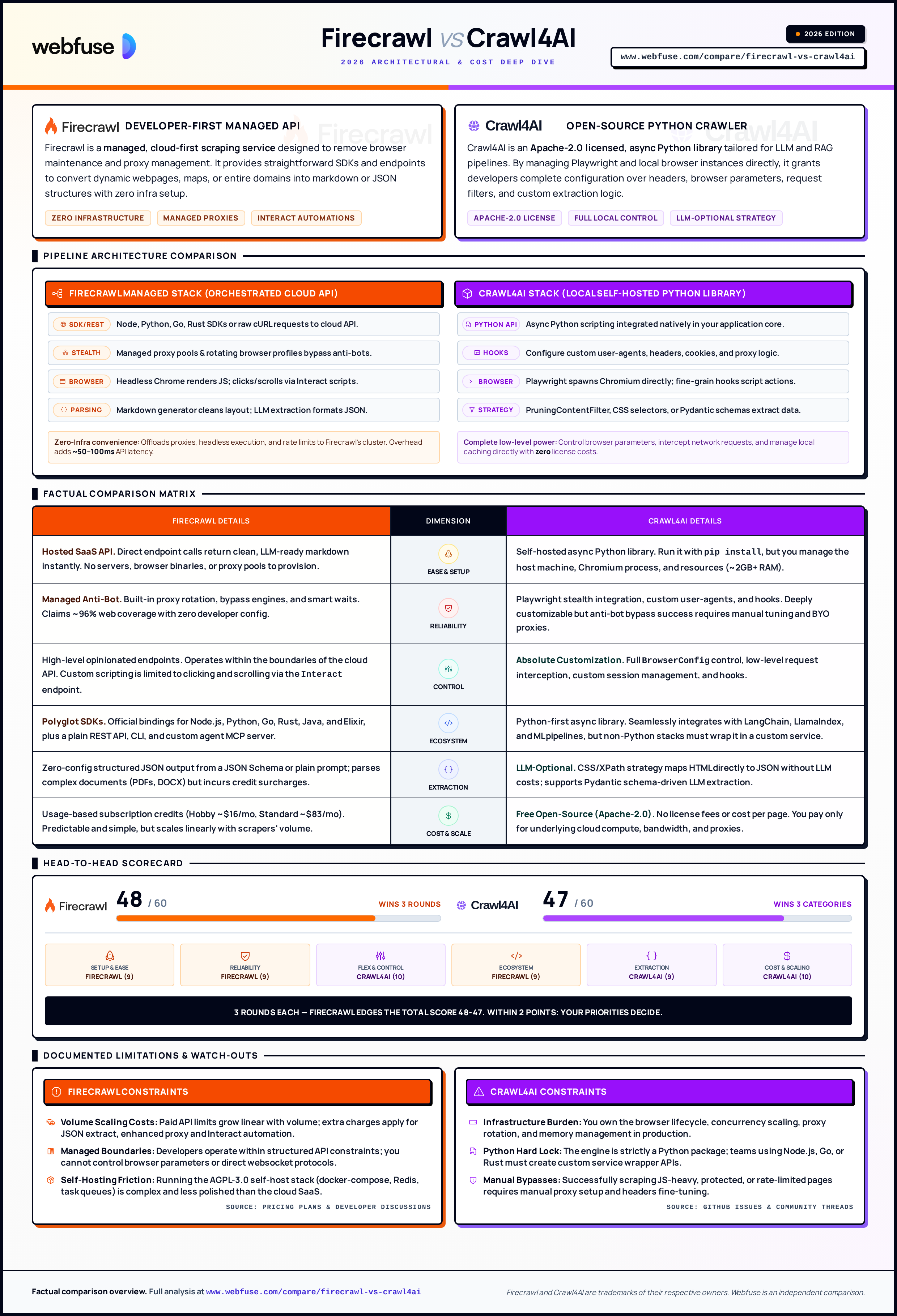
Comparison cheat sheet (click to open)
Quick Quiz
Answer five questions and we'll tell you which tool fits your project - Firecrawl or Crawl4AI.
/
Your needs pull both ways - managed reliability versus self-hosted control and cost. Many teams use both: Crawl4AI for the bulk of pages and Firecrawl for the tough ones. Run a quick proof-of-concept on your real target sites and let success rate and cost decide.
The TL;DR
Decide by what dominates your project - the score is close, the positioning isn't.
// Managed, API-first // Open-source, self-hostedHead-to-head
Six categories, scored head-to-head. Click any round to see how each platform performs and why.
Firecrawl is a hosted API - sign up, call an endpoint, and get clean Markdown back with no infrastructure, plus a playground and natural-language queries. Crawl4AI is a Python library you install and configure yourself; powerful, but you manage the browser, environment, and runtime.
Winner Firecrawl is a hosted API - sign up, call an endpoint, and get clean Markdown back with no infrastructure, plus a playground and natural-language queries. Crawl4AI is a Python library you install and configure yourself; powerful, but you manage the browser, environment, and runtime.
Winner Final Tally
Here's how the scores add up across all six categories.
// Managed, API-first
// Open-source, self-hosted
Both fetch pages as an anonymous crawler.
Webfuse reads the live , signed-in session.
Pricing - full picture
This is the clearest divide. Firecrawl is a paid, usage-based API (free tier, then credit subscriptions); Crawl4AI is free and open source, so you pay only for infrastructure and any LLM tokens. Below is how that shapes up at three volumes. Figures are illustrative as of mid-2026 - check vendor pages and model with your own sites.
// How the bill is built
~100k credits/month on the Standard tier; managed proxies, browsers, and concurrency included.
≈ $83 / mo
predictable subscription
$0 license. Run it on a small server; pay for compute, bandwidth, and proxies if you need stealth.
infra only
no per-page fee
Schema/prompt extraction calls an LLM. Firecrawl adds credit surcharges; Crawl4AI bills your own tokens (or local Ollama).
$ tokens
roughly tool-agnostic
At low and mid volume, Firecrawl's managed credits are simple and cheap enough that running your own infra rarely pays off. Past high volume, Crawl4AI's infra-only model is usually cheaper - but you own scaling, proxies, and uptime. LLM-based extraction adds token cost either way. Model both against your real target sites.
Where each one breaks
Every comparison shows strengths. Few show where each tool actually breaks. Below are documented limitations from production users, GitHub issues, and community threads. Knowing these up front is worth more than another feature bullet.
Usage-based credits are predictable but grow with pages crawled, and advanced features (JSON extract, enhanced proxy, Interact) add surcharges.
The AGPL self-host repo (Redis, docker-compose, services) is less polished than the cloud; community reports mixed ease.
You operate within the managed API rather than the browser internals, so very custom crawl logic can be harder to express.
Rate limits, pricing changes, and availability are the vendor’s to set - a consideration for long-lived, high-volume pipelines.
It is a Python library first; non-Python stacks must wrap it in their own service, unlike Firecrawl’s broad SDKs and REST API.
Browsers, proxies, scaling, and uptime are yours to operate for production - real ops work versus a managed API.
Success on JS-heavy or anti-bot pages can be hit-or-miss without configuring stealth, proxies, and waits yourself.
First clean result takes more configuration than a hosted API call, and self-host hardening is on you.
Both lists draw on documented user feedback, analyst notes, and review platforms as of mid-2026. Both vendors ship fast - any of these can move to the strengths column in a given quarter.
Use Case Picks
Six common scenarios with a defended pick.
A managed API returns clean, reliable data with no infra to run.
Full BrowserConfig, hooks, and extraction control, no lock-in.
Managed proxies and rotating browsers handle protection for you.
No per-page fees - infra-only cost wins as volume climbs.
Official SDKs across languages plus a plain REST API.
Python-native, LLM-optional extraction tuned for clean Markdown.
FAQ
The honest answers - drawn from real product positioning, not press releases.
Firecrawl is a managed, API-first platform - you call an endpoint and it returns clean, LLM-ready data, handling proxies, JavaScript, and anti-bot for you. Crawl4AI is an open-source Python library you self-host and configure, giving full control over the browser, crawl, and extraction with no vendor lock-in. Firecrawl optimizes for reliability and zero infrastructure; Crawl4AI optimizes for control and cost.
Yes. Crawl4AI is fully open source under Apache-2.0 with no per-page fees. Your costs are infrastructure (a server with ~2GB+ RAM for Chromium, plus bandwidth and proxies if needed) and any LLM tokens you spend on LLM-based extraction - which you can avoid entirely with CSS/XPath extraction or a local model like Ollama.
Firecrawl has open-source components and a self-hostable repo under AGPL-3.0, but it is primarily used as a managed cloud API. The self-host path (Redis, docker-compose, supporting services) is more involved than the hosted product, which is where most teams run it.
Firecrawl, out of the box. It manages rotating proxies, browsers, smart waits, and anti-bot handling, claiming around 96% web coverage. Crawl4AI can reach the same sites using Playwright with stealth and your own proxies, but dependable success on hard dynamic pages takes more tuning.
It depends on volume. At low and mid volume, Firecrawl’s managed credits (free tier, ~$16/mo Hobby, ~$83/mo for 100k credits) are simple and cheap enough that self-hosting rarely pays off. At high volume, Crawl4AI’s infra-only model is usually cheaper because there are no per-page fees - but you operate the servers, proxies, and scaling yourself.
Both produce clean, token-efficient Markdown that strips navigation and ads. Firecrawl is stronger at zero-config structured output - JSON via schema or natural-language prompt. Crawl4AI is more flexible: fast CSS/XPath with no LLM, schema-driven LLM extraction, and content filters like PruningContentFilter to tune the output.
Yes, and many teams do. A common hybrid runs Crawl4AI for the bulk of pages (cheap, self-hosted) and falls back to Firecrawl for the tough, anti-bot, or JS-heavy pages where its managed reliability earns its cost.
Yes. Firecrawl offers official SDKs for Python, Node.js, Go, Rust, Java, and Elixir, plus a plain REST API and CLI - so any stack can use it. Crawl4AI is Python-first, so non-Python teams typically wrap it in their own service.
Both target this directly. Firecrawl offers managed search, an MCP server, and agent skills for tools like Claude and Cursor, which is convenient for production agents. Crawl4AI gives self-hosted control with adaptive crawling and LLM-optional extraction, which suits cost-sensitive or highly customized RAG pipelines.
Firecrawl and Crawl4AI extract and automate web content in their own headless browsers - ideal for feeding data to LLMs or RAG. They are not built to inject an AI agent into a live end-user session on a third-party site you do not control. To run agents, co-browsing, or augmentation on top of a website without modifying its source, you need a web-augmentation layer like Webfuse, which serves the site through a proxied session you can script and observe.
Headless browsers give your agent a copy of the web. Webfuse gives it the session your user is actually in — over MCP, with no install.