

Enterprise AI Comparison

Cognigy vs Parloa

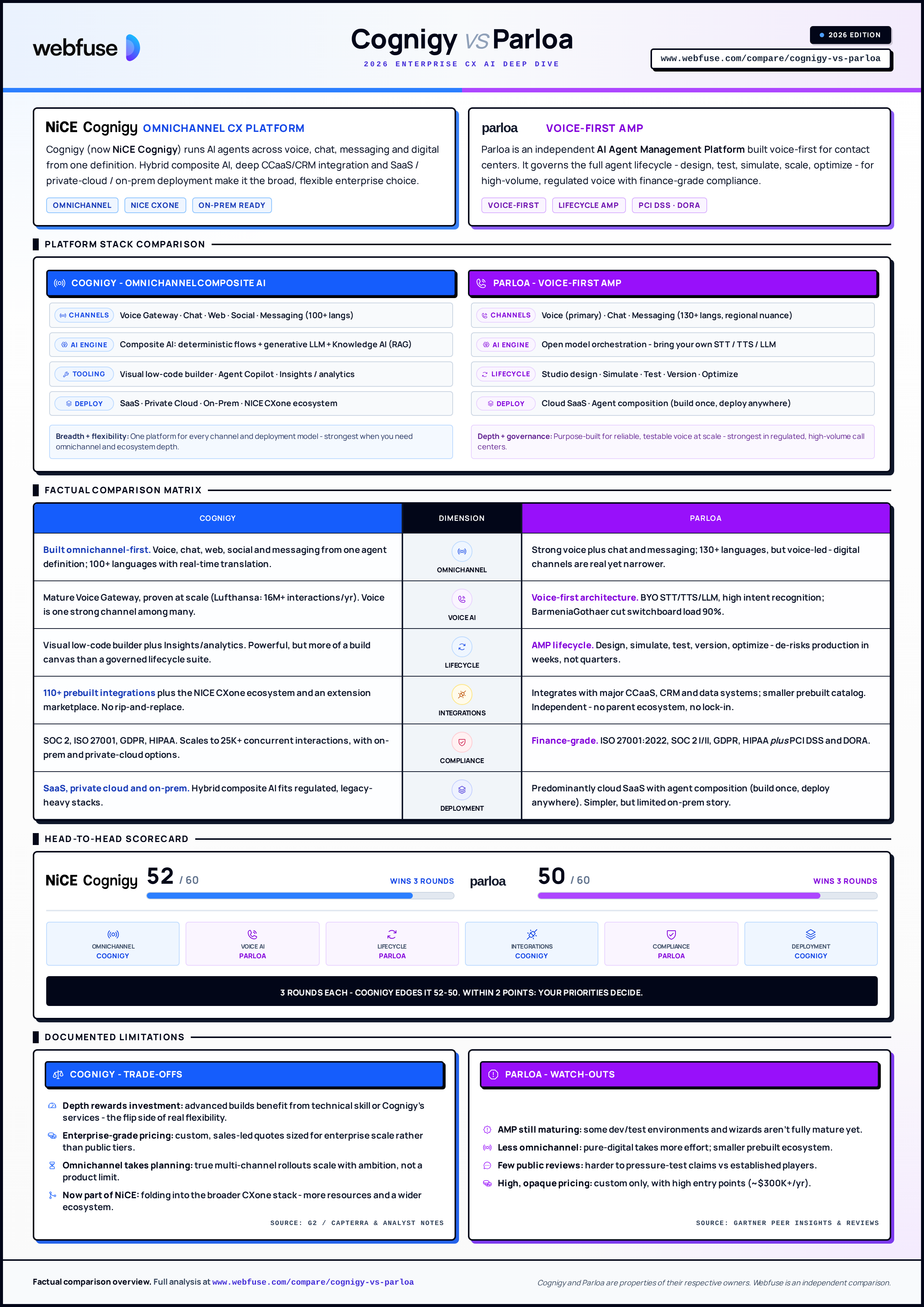
Cognigy (now NiCE Cognigy) is an omnichannel enterprise CX platform, while Parloa is a voice-first AI Agent Management Platform built around lifecycle governance. Across six dimensions, they score 52 and 50 out of 60 - the right pick comes down to one question: do you need omnichannel breadth or voice-first depth.

Updated8 min read
Open PNG
Cognigy vs Parloa comparison cheat sheet

Comparison cheat sheet (click to open)

Quick Quiz

Not sure which to pick?

Answer five questions and we'll tell you which platform fits your contact center - Cognigy or Parloa.

// Your setup

Primary contact channel?
What matters most?
Your industry?
Deployment preference?
Existing CX stack?
Recommendation
Cognigy

NiCE Cognigy

Your answers point at omnichannel breadth, deep ecosystem integration, or deployment flexibility - exactly what Cognigy (now NiCE Cognigy) is built for. You trade some voice-first focus for a wider, more configurable platform.

Cognigy Match11 / 14
Parloa Match1 / 12
Jump to Cognigy strengths

The TL;DR

Two platforms. Two sweet spots.

Decide by what dominates your contact center - the score is close, the positioning isn't.

Cognigy // Omnichannel agentic AI

Pick Cognigy if...

  • You need true omnichannel - voice plus digital - from one platform
  • Deep CCaaS/CRM integration and the NICE CXone ecosystem matter
  • You want deployment choice, including private cloud or on-prem
  • Hybrid deterministic + generative AI for compliance-sensitive flows
  • You value a long, proven enterprise track record at massive scale
Parloa // Voice-first agent management

Pick Parloa if...

  • Voice is your primary, highest-volume contact channel
  • You operate in finance or regulated sectors needing PCI DSS / DORA
  • Lifecycle governance - simulate, test, version - is a hard requirement
  • You want fast, reliable voice deployments with no parent-platform roadmap
  • Independence and BYO model orchestration matter to you

Head-to-head

The 6 Comparison Rounds

Six categories, scored head-to-head. Click any round to see how each platform performs and why.

Round 1 of 6

Omnichannel Breadth

Winner: Cognigy

Cognigy was built omnichannel-first - voice, chat, messaging, and digital from one agent definition, with 100+ languages and real-time translation. Parloa is excellent but voice-led; its digital channels are real and growing, just narrower than Cognigy's mature multi-channel surface.

Cognigy Winner
10/10
  • Voice, chat, web, social, and messaging from one agent definition
  • 100+ languages with real-time translation across channels
  • Voice Gateway for telephony plus rich digital and web widgets
  • Blended journeys that hand off across channels mid-conversation
  • 1,250+ brands, billions of interactions handled annually
Parloa
7/10
  • Strong voice plus chat and messaging channels
  • 130+ languages with regional nuance, tuned for spoken dialogue
  • Channel breadth growing, but voice remains the core surface
  • Best when voice is the primary contact channel, digital secondary

Final Tally

Within 2 points - your priorities decide.

Here's how the scores add up across all six categories.

// Omnichannel agentic AI

52/ 60
Overall score87%

Category Ratings

  • Omnichannel Breadth10/10
  • Voice AI8/10
  • Lifecycle & Governance7/10
  • Integrations & Ecosystem10/10
  • Security & Compliance8/10
  • Deployment & Flexibility9/10

// Voice-first agent management

50/ 60
Overall score83%

Category Ratings

  • Omnichannel Breadth7/10
  • Voice AI10/10
  • Lifecycle & Governance10/10
  • Integrations & Ecosystem7/10
  • Security & Compliance9/10
  • Deployment & Flexibility7/10

Pricing - full picture

Both are quote-based. Here's the shape of it.

Both Cognigy and Parloa are enterprise-only with custom, quote-based pricing - there are no public self-serve tiers. The figures below are drawn from vendor statements, analyst notes, and third-party estimates as of mid-2026. Treat them as directional and confirm with sales.

Cognigy
// mid
Custom
Conversation + voice-line based
Mid-market fit8/10
  • Billed on conversations, concurrent voice lines, and Knowledge AI usage
  • Omnichannel coverage across voice and digital in one contract
  • Volume discounts negotiated into annual terms
Parloa
// mid
Custom
Annual, voice-volume led
Mid-market fit7/10
  • Annual contracts sized to call volume
  • Voice-first economics - strongest when calls dominate
  • Lifecycle tooling (test, simulate, version) included

// How the bill is built

What actually drives the bill

Cognigy

Billed on conversations, concurrent voice lines, and Knowledge AI usage. Pilots can start around $2,500/mo; full deployments run into six figures annually, usually on multi-year terms.

Conversation + line based

pilots from ~$2,500/mo

Parloa

Annual contracts sized to call volume, voice-volume led. Third-party estimates put entry points around $300K+/yr, with partner financing available.

Volume-based annual

$300K+/yr typical

Neither vendor publishes a price list, and real numbers swing widely with interaction volume, channel mix, and deployment model. Model both against your own volume and get written quotes before comparing - per-conversation economics differ a lot from a voice-line model.

Where each one breaks

The honest stuff vendor pages skip.

Every comparison page lists strengths. Few show where each platform actually strains. Below are documented limitations from analyst notes, G2 / Capterra / Gartner Peer Insights reviews, and customer feedback as of mid-2026. Knowing them up front beats another feature bullet.

Depth that rewards investment

Cognigy is a deep platform - advanced, custom builds benefit from technical skill or Cognigy's professional services. The flip side of that flexibility is a real ramp-up.

Enterprise-grade, quote-based pricing

Pricing is custom and sales-led rather than public-tier, sized for enterprise deployments. Best fit when you are buying at that scale; smaller teams should scope carefully.

Omnichannel scope takes planning

Standing up true omnichannel across voice, chat, and digital is a bigger undertaking than a single-channel rollout - the timeline scales with the ambition, not a product limitation.

Advanced analytics still deepening

Some teams want richer out-of-the-box analytics; in practice these are often extended through BI and integration tooling.

Now part of NiCE

As NiCE Cognigy, it is being folded into the broader CXone stack - which brings more resources and a wider ecosystem. Worth tracking how packaging and roadmap evolve.

AMP still maturing in places

Some reviewers note dev/test environments and setup wizards are not fully mature yet relative to older platforms.

Voice-first means less omnichannel

Pure-digital use cases take more effort, and the prebuilt ecosystem is smaller than Cognigy's.

Limited public review volume

Far fewer independent reviews than established players, so claims are harder to pressure-test.

High, opaque pricing

Custom enterprise pricing only, with high entry points - third-party estimates often cite $300K+/yr.

Best run with technical teams

Complex deployments lean on engineering resources; the curve is steeper for non-technical users.

Both lists draw on documented user feedback, analyst notes, and review platforms as of mid-2026. Both vendors ship fast - any of these can move to the strengths column in a given quarter.

Use Case Picks

Which one wins for your use case?

Six common contact-center scenarios with a defended pick.

Winner:Cognigy

Omnichannel customer service

Voice + digital from one agent, 100+ languages, deep CCaaS ties.

Winner:Parloa

High-volume voice / call center

Voice-first AMP tuned for natural, reliable phone dialogue at scale.

Winner:Parloa

Finance & regulated sectors

PCI DSS and DORA on top of SOC 2 / ISO / HIPAA for high-stakes flows.

Winner:Cognigy

Airlines, automotive, manufacturing

Proven at Lufthansa, Toyota, Mercedes, and Bosch at massive scale.

Winner:Cognigy

On-prem / private cloud requirement

SaaS, private cloud, and on-prem options for rip-out-resistant stacks.

Winner:Parloa

Governed rollout (simulate to scale)

AMP lifecycle - design, test, version, optimize - de-risks production.

FAQ

Questions people actually ask

The honest answers - drawn from real product positioning, not press releases.

What is the main difference between Cognigy and Parloa?

Cognigy is an enterprise omnichannel conversational AI platform - now NiCE Cognigy after the 2025 NICE acquisition - covering voice, chat, messaging, and digital with deep ecosystem integration and flexible deployment. Parloa is an independent, voice-first AI Agent Management Platform (AMP) focused on the full agent lifecycle for high-volume, regulated voice. They overlap, but they optimise for different things.

Is Cognigy still independent after the NICE acquisition?

No. Cognigy was acquired by NICE in 2025 and is now branded NiCE Cognigy, integrated into the NICE CXone ecosystem. The upside is NICE's resources and a broader CX stack; the trade-off is a parent-platform roadmap and packaging dependency. Parloa, by contrast, remains independent.

Which one is better for voice?

Parloa is purpose-built voice-first, with model orchestration (BYO STT/TTS/LLM) and lifecycle tooling tuned for live phone calls in regulated, high-volume centers. Cognigy's voice is strong and proven at huge scale (Lufthansa handles 16M+ interactions a year), but voice is one channel within a broader omnichannel suite rather than the whole product.

Which one is better for omnichannel?

Cognigy. It was built omnichannel-first - voice, chat, messaging, and digital from a single agent definition, with 100+ languages and real-time translation. Parloa supports multiple channels but leads with voice, so pure-digital and blended journeys take more effort.

How do Cognigy and Parloa price?

Both are enterprise-only with custom, quote-based pricing and no public tiers. Cognigy pilots can start around $2,500/mo, with full deployments reaching six figures annually on multi-year terms. Parloa contracts are sized to call volume, with third-party estimates often citing $300K+/yr entry points and partner financing available. Get written quotes against your own volume.

Which is more compliant for finance and regulated sectors?

Both are strong. Parloa leans hardest into regulation, adding PCI DSS and DORA on top of SOC 2 Type I/II, ISO 27001:2022, GDPR, and HIPAA - it positions explicitly for finance. Cognigy covers SOC 2, ISO 27001, GDPR, and HIPAA, and adds deployment options (including on-prem and private cloud) that many regulated buyers require.

Can I deploy either platform on-premises?

Cognigy offers SaaS, private cloud, and on-prem deployment, which suits heavily regulated or legacy-heavy environments. Parloa is predominantly cloud SaaS, which is faster to stand up but offers less optionality if on-prem is a hard requirement.

How long does it take to get to production?

Parloa emphasises fast, governed rollouts - its AMP testing, simulation, and versioning are designed to take agents live in weeks while controlling risk. Cognigy can take longer for complex omnichannel builds, but offers more configurability and a larger prebuilt integration catalog to draw on.

Can I run a Cognigy or Parloa agent on a website I do not own?

Not natively. Both deploy through their own channels and SDKs that you embed into properties you control. To place a Cognigy or Parloa agent onto a live third-party website without changing its source, you need a web-augmentation layer like Webfuse that injects the agent through a proxied session.